The WeChat Mini Games market in China is experiencing rapid expansion, serving as a critical segment of the broader gaming industry. As of 2026, the market is characterized by high user engagement, with daily playtimes exceeding 60 minutes and over 100 million daily in-game social interactions. The audience is notably broad, with a demographic split of 53% male and 47% female, and a significant concentration of players residing in tier-3 cities or below. Half of the total user base falls within the 24-40 age range.
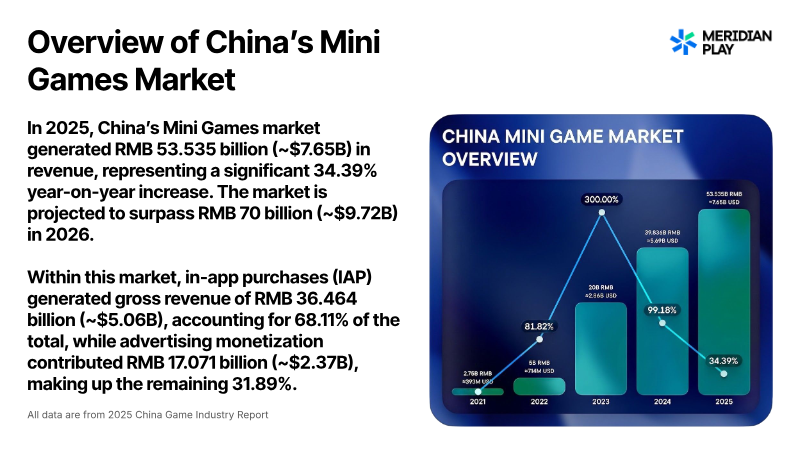
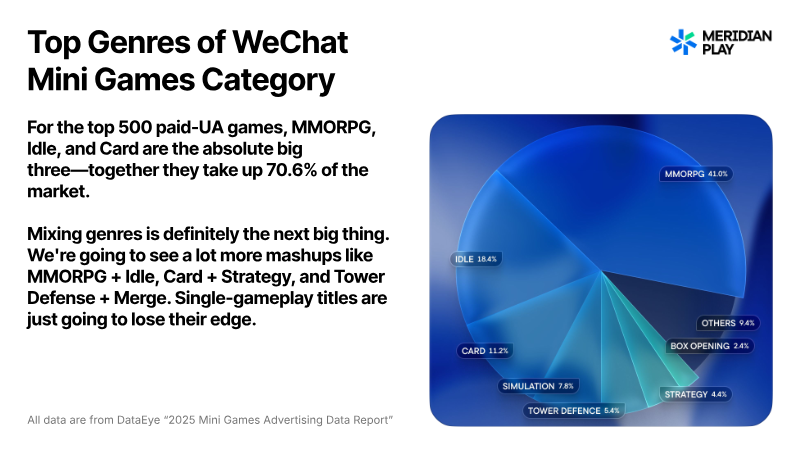
Market performance remains strong, reaching RMB 53.535 billion (approximately $7.65 billion) in 2025, representing a 34.39% year-over-year increase. Projections indicate the market will surpass RMB 70 billion in 2026. Revenue is primarily driven by in-app purchases, which accounted for 68.11% of the total, while advertising revenue comprised the remaining 31.89%. Competition is intensifying, evidenced by more than 51,000 games running paid advertisements in 2025 and over 9,000 titles currently in development. The competitive landscape is dominated by MMORPG, Idle, and Card genres, though there is a clear trend toward more complex, hardcore titles.
Operating within this ecosystem requires navigating specific regulatory and technical frameworks. Foreign developers must partner with local entities to secure necessary ISBN licenses. Furthermore, developers must adhere to strict technical constraints, including a 4MB main package limit and a 1GB memory cap, with official support limited to specific engines like Cocos and Laya. While platforms like Douyin are growing rapidly in terms of new paid-UA titles, WeChat maintains a larger absolute market share and higher platform penetration, supported by a structured revenue-sharing model and growth-based incentive programs for developers.