
Institute for Advanced Architecture of Catalonia
Organization2 reports
The Institute for Advanced Architecture of Catalonia (IAAC) is a Barcelona-based architecture, urban technology and design school and research center. It publishes research reports such as one on using games and play in public urban spaces.
Documents
Report113 pages
Public Play Space: Turning Urban Spaces into Public Places with Games and Play
The "Public Play Space" project, co-funded by the Creative Europe Programme from 2019-2021, investigates the transformative potential of games and play, integrated with advanced digital technologies, to foster co-design and co-habitation in urban environments.
- The authors argue European cities facing climate change, migration, urbanisation, economic change, and COVID-19 cannot rely on top-down planning alone, and that grassroots participatory placemaking supported by playful, gamified methods is needed to secure resident buy-in.
- The project (2019–2021, co-funded by Creative Europe) centred on Barcelona, Palermo, and Breda, with supplementary cases in Varese, Olot, Brazilian cities, and Barcelona's Raval district, and produced a State-of-the-Art Catalogue analysing 30 best-practice cases.
- A Breda event using the SCITHOS serious game found that 65% of 24 surveyed participants gained awareness of new issues and 85% gained insight into planning complexity; the online virtual exhibition exceeded 25,000 accesses and the international symposium drew about 500 participants.
Institute for Advanced Architecture of CataloniaJan 2021
Report109 pages
Public Play Space Symposium Proceedings 2021
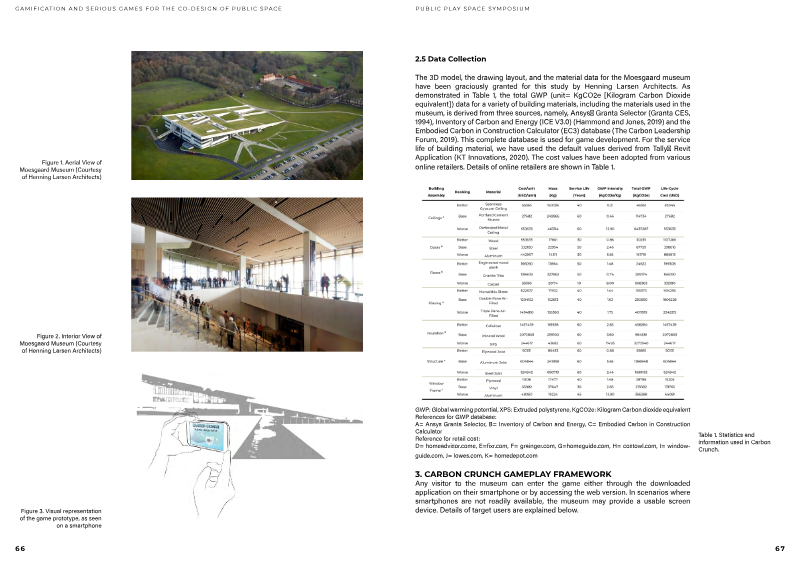
The 2021 Public Play Space Symposium Proceedings examine how gamification, responsive digital technologies, board and sandbox games, augmented reality, and playful interventions can support participatory co-design of public space.
- Serious games and gamified interfaces consistently boost engagement, collaboration, and educational value, especially with children, though individual-level data collection and facilitator dependence remain limitations.
- Play is argued to lower barriers to citizen engagement in urban planning, making participation more appealing, measurable, and sustained.
- Board-game experiments in Portugal found that collaborative groups produced more efficient transport networks.
Institute for Advanced Architecture of CataloniaJan 2021