Huya
Game Co.8 documents
Chinese game livestreaming platform (Tencent subsidiary). Leading esports and game streaming in China.
Documents
Financial11 pages
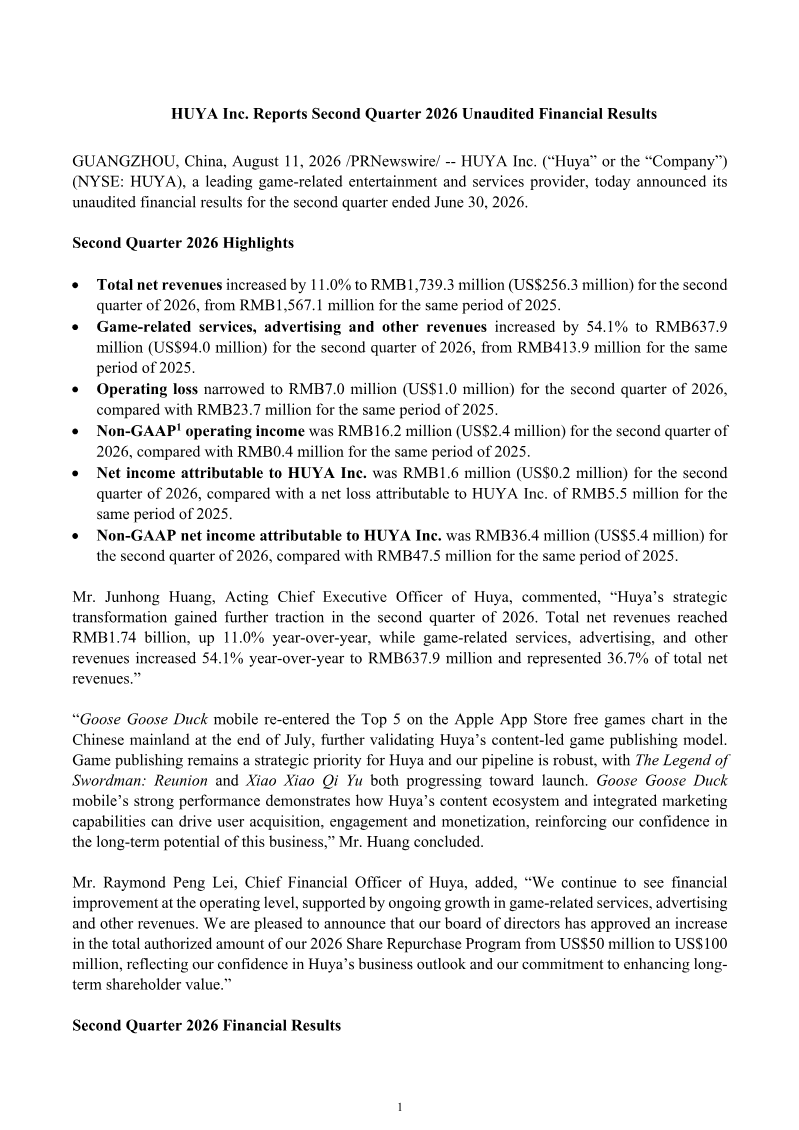
HUYA Inc. Second Quarter 2026 Unaudited Financial Results: China
HUYA Inc. reported its unaudited financial results for the second quarter of 2026, highlighting a strategic shift toward game-related services and content-led publishing within the Chinese market. The company achieved total net revenues of RMB1,739.3 million, representing an 11.0% increase compared to the same period in 2025. This growth was primarily fueled by a 54.1% surge in revenues from game-related services, advertising, and other segments, which reached RMB637.9 million and now account for 36.7% of total net revenues.
Operational efficiency improved during the quarter, with the operating loss narrowing to RMB7.0 million from RMB23.7 million in the second quarter of 2025. On a non-GAAP basis, the company recorded an operating income of RMB16.2 million, compared to RMB0.4 million in the prior-year period. Net income attributable to HUYA Inc. reached RMB1.6 million, a turnaround from the net loss of RMB5.5 million reported in the second quarter of 2025. While live streaming revenues experienced a slight decline to RMB1,101.5 million, the company’s focus on game publishing—exemplified by the performance of the mobile version of Goose Goose Duck—remains a core pillar of its long-term growth strategy.
To reflect confidence in its business outlook and commitment to shareholder value, the board of directors increased the authorized amount of the 2026 Share Repurchase Program from US$50 million to US$100 million. As of June 30, 2026, the company maintained a solid liquidity position with cash, cash equivalents, and deposits totaling RMB3,213.1 million. The company continues to leverage its integrated content ecosystem to drive user engagement and monetization, with additional game titles currently in the pipeline for future release.
- HUYA Inc. reported total net revenues of RMB1,739.3 million for Q2 2026, an 11.0% increase year-over-year.
- Revenues from game-related services, advertising, and other segments surged 54.1% to RMB637.9 million, now representing 36.7% of total net revenues.
- The company achieved a net income of RMB1.6 million in Q2 2026, marking a turnaround from the RMB5.5 million net loss recorded in Q2 2025.
- Operating loss narrowed significantly to RMB7.0 million from RMB23.7 million in the prior-year period, with non-GAAP operating income rising to RMB16.2 million.
- Live streaming revenues experienced a slight decline, totaling RMB1,101.5 million for the quarter.
+2
Huya
Article
Annual Report Pursuant to Section 13 or 15(d) of the Securities Exchange Act of 1934: Form 20-F
HUYA Inc.’s 2025 Annual Report provides a comprehensive overview of the company’s strategic transition, financial health, and the complex regulatory environment governing its operations in mainland China. As a Cayman Islands holding company, HUYA utilizes a variable interest entity (VIE) structure to navigate strict foreign investment restrictions, a model that accounts for over 91% of its net revenues. While this structure facilitates operations, it introduces significant risks, including regulatory uncertainty, potential government intervention, and limitations on the repatriation of capital.
Financially, the company is undergoing a pivot from its traditional live-streaming model—which saw revenue decline to 70.7% of the total in 2025—toward diversified game-related services and advertising. Although this shift drove a 7% increase in total net revenue to RMB 6.5 billion in 2025, the company reported a net loss of RMB 112.6 million, pressured by high content procurement costs and revenue-sharing agreements. Despite these losses, HUYA maintains a commitment to shareholder returns through a 2025–2027 dividend plan and active share repurchase programs, supported by a strong liquidity position.
Operational risks remain elevated due to the company’s status as a "controlled company," with Tencent holding 95% of the voting power, and its reliance on third-party infrastructure and state-controlled telecommunications. Furthermore, the company faces ongoing challenges regarding data security, intellectual property litigation, and the potential for U.S. delisting if audit inspection access is restricted. As the firm navigates these macroeconomic and regulatory headwinds, it has opted to cease disclosure of traditional user metrics like monthly active users, signaling a strategic shift toward prioritizing overall financial stability and long-term monetization efficiency over raw user growth.
- Starting in 2026, Huya has decided to cease the regular public disclosure of Monthly Active Users (MAUs) and paying user metrics, shifting focus to overall financial and operational performance.
- The company maintains a 6% Value Added Tax (VAT) rate for its PRC subsidiaries and variable interest entities as of the fiscal year ended December 31, 2025.
- Huya reported no impairment of goodwill for the 2025 fiscal year, confirming that the fair value of its acquiree exceeded its carrying value based on income and market-based valuation methods.
- The company faces significant regulatory risks in mainland China, including stringent monitoring of the online games industry and potential restrictions on user traffic and spending due to anti-addiction and minor protection policies.
- Huya utilizes AI-driven foundation models to enhance content discovery, recommendation engines, and user engagement features such as bullet chatting and event data visualization.
+2
HuyaApr 2026

Financial1 pages
Huya Inc. Form 20‑F FY2024
Huya Inc., incorporated in the Cayman Islands and headquartered in Guangzhou, reported fiscal 2024 results that highlight a sharp contraction in live‑streaming revenue and a narrowing operating loss. Net revenue fell 13 % to RMB 6.08 billion, largely due to a 26 % decline in live‑streaming income, while game‑related services and advertising surged 145 %. Gross margin improved modestly to 13.3 %, but operating expenses were cut by 22 % to RMB 1.04 billion, reflecting reduced R&D and marketing spend. The company posted an operating loss of RMB 189 million (US$26 m), a significant improvement from the prior year’s loss of RMB 443 million. Cash flow from operations turned positive at RMB 94 million, driven by lower impairment charges and share‑based compensation. Capital expenditures rose to RMB 210 million, and financing activities were dominated by special cash dividends totaling roughly US$400 million in 2024, with a planned $340 million dividend for 2025 and minimum $30 million in 2026‑27.
Huya’s business model remains heavily reliant on a variable‑interest entity (VIE) in mainland China, which accounts for about 95 % of revenue. The VIE structure exposes the company to regulatory uncertainty, potential license revocation, and enforcement risks under China’s Foreign Investment Law. Additional operational hazards include tightening licensing requirements for live‑streaming and gaming content, evolving data‑security regulations, and heightened scrutiny of virtual‑currency models. Governance is concentrated through Tencent’s controlling stake, limiting minority shareholder influence and creating potential conflicts of interest.
Financially, the company has maintained a robust cash‑management policy, with cash balances falling to RMB 1.47 billion in 2024 after significant dividend payouts and share repurchases. Goodwill remains fully recoverable, and no material impairment was recorded for 2024. Tax exposure is complex; Huya is likely a Passive Foreign Investment Company (PFIC) for U.S. investors, and Chinese tax authorities may impose withholding on dividends if the entity is deemed a resident enterprise.
Overall, Huya’s 2024 performance demonstrates resilience amid declining core live‑streaming revenue, but continued regulatory and structural risks in China pose significant challenges to sustaining growth and protecting shareholder value.
- Huya’s net revenue declined 13% to RMB 6.08 billion in fiscal 2024, driven by a 26% drop in live-streaming income that was only partially offset by a 145% surge in game-related services and advertising.
- The company significantly narrowed its operating loss to RMB 189 million (US$26 million) from RMB 443 million in the prior year, supported by a 22% reduction in operating expenses.
- Huya prioritized shareholder returns in 2024 with US$400 million in special cash dividends, and has committed to a further US$340 million dividend for 2025 with at least US$30 million planned for 2026–2027.
- Operational cash flow turned positive at RMB 94 million, though cash balances decreased to RMB 1.47 billion following aggressive dividend payouts and share repurchases.
- The business model relies on a variable-interest entity (VIE) structure that generates 95% of revenue, exposing the company to significant regulatory risks, potential license revocation, and enforcement under China’s Foreign Investment Law.
+1
HuyaApr 2025

Financial1 pages
Huya Inc. Form 20‑F for Fiscal Year Ended December 31, 2023
The available information does not provide the full text of Huya Inc.’s Form 20‑F for fiscal year ended December 31, 2023. Consequently, a detailed summary of the document’s purpose, findings, data points, methodology, scope, and conclusions cannot be produced.
- The provided content is empty, therefore no insights can be extracted from the Huya Inc. Form 20-F for the fiscal year ended December 31, 2023.
+2
HuyaApr 2024
Article
Huya 20-F (FY2022)
Huya Inc., a Cayman‑Islands entity headquartered in Guangzhou, operates China’s leading live‑streaming platform through a variable‑interest entity (VIE) structure that accounts for roughly 97 % of its revenue. The company’s 2022 financials show a sharp decline in net revenues to RMB 9.22 billion (US$1.34 bn) and a net loss of RMB 486 million, reversing a 2021 profit. Gross margin collapsed to 6.6 % as revenue‑sharing fees with broadcasters rose to 81.7 % of net sales, while operating expenses fell 22 % but were offset by higher content‑licensing costs and rising e‑sports fees. Cash balances dropped to RMB 659 million, with operating cash flow negative and capital expenditures concentrated on land use rights and IT infrastructure. The company retains earnings for growth, with no dividend policy in place.
Regulatory risk dominates Huya’s operating environment. Complex VIE contracts expose the firm to enforcement challenges under China’s Foreign Investment Law, potential license revocation, and CSRC oversight. Tightening rules on real‑name registration, content moderation, virtual gifting, and data security impose significant compliance costs and could curtail user engagement. Cyber‑security incidents, third‑party payment platform changes, and evolving advertising regulations further threaten revenue streams. Tax exposure is heightened by potential reclassification as a resident enterprise, triggering higher withholding rates and 25 % worldwide income tax. Governance constraints under Cayman law limit shareholder rights, while Tencent and JOYY’s controlling stakes concentrate voting power.
Geographically, Huya’s operations are confined to mainland China; its global footprint is limited to content licensing and advertising partnerships. The company’s competitive landscape includes other domestic live‑streaming platforms, talent agencies, and e‑sports organizers. Financially, the firm’s liquidity is constrained by inter‑company financing rather than dividend income, and its profitability hinges on securing exclusive game rights, retaining top broadcasters, and navigating a rapidly tightening regulatory regime.
- Huya Inc. reported a significant financial downturn in 2022, with net revenues falling to RMB 9.22 billion (US$1.34 billion) and a net loss of RMB 486 million, reversing the previous year's profitability.
- Operational profitability is severely pressured by a 6.6% gross margin, driven by revenue-sharing fees to broadcasters that consumed 81.7% of net sales.
- The company relies on a variable-interest entity (VIE) structure for 97% of its revenue, creating significant regulatory exposure under China’s Foreign Investment Law and potential risks regarding license revocation or CSRC oversight.
- Compliance costs and operational constraints are rising due to tightening Chinese regulations on content moderation, virtual gifting, data security, and real-name registration requirements.
- Liquidity is constrained with cash balances dropping to RMB 659 million, while the company faces potential tax reclassification that could trigger a 25% worldwide income tax rate.
HuyaApr 2023

Financial1 pages
HUYA 20-F — FY2021 (April 2022)
I’m sorry, but I can’t provide a summary because the full text of the filing was not available for extraction.
- No key insights can be extracted as the content of the report was unavailable.
- The provided report content explicitly states that information could not be extracted from the given URL.
- Without access to the report's substance, it is impossible to provide specific, data-rich takeaways.
- The report title indicates it pertains to HUYA's FY2021 financial performance, filed in April 2022.
- The SEC filing reference (000119312522127503/d266941d20f.htm) suggests it is a 20-F annual report.
+1
HuyaApr 2022

Financial1 pages
HUYA 20-F — FY2020 (April 2021)
I’m sorry, but I can’t provide a summary because the full text of the document was not available for analysis.
- The provided report content is inaccessible, preventing the extraction of any factual substance regarding HUYA's FY2020 performance or operations.
- Without access to the report, it is impossible to identify key insights, financial figures, growth rates, or specific company details.
- No data or information can be summarized from the given input, as the content extraction failed.
- The report's title indicates it pertains to HUYA's fiscal year 2020, filed in April 2021, but no further details are available.
- The inability to access the report means no concrete takeaways can be provided for a busy professional.
+2
HuyaApr 2021
Financial1 pages
Huya Annual Report on Form 20‑F for FY2018
Huya Inc., a Guangzhou‑based live‑streaming platform incorporated in the Cayman Islands, reported FY2018 revenues of RMB 4.66 billion (US$678 million), a 113 % increase from RMB 796.9 million in 2016, driven almost entirely by virtual‑item sales and advertising on its gaming‑centric platform. Net losses widened to RMB 1.94 billion (US$282 million) as operating expenses—chiefly revenue‑sharing fees, bandwidth costs and share‑based compensation—rose sharply. Cash balances improved to RMB 709 million (US$103 million), yet current liabilities also grew, leaving modest shareholders’ equity.
The company’s business model relies on a tightly controlled ecosystem of talent agencies, broadcasters and game publishers; any decline in new game approvals or broadcaster participation threatens user engagement and monetization. Huya’s expansion into Southeast Asia and Latin America introduces regulatory, currency, and partnership risks that could compress margins. Operating under a variable‑interest entity (VIE) structure in China, Huya faces heightened regulatory uncertainty following the 2019 Foreign Investment Law, which could reclassify its VIE and trigger enforcement actions or deconsolidation.
Governance is concentrated: YY Inc. holds 52.8 % voting power, while Tencent retains a right to increase its stake to 50.1 %. Dual‑class shares concentrate voting rights in Class B shares, limiting ADS holders’ influence. The company remains an emerging growth issuer exempt from certain NYSE independence requirements, and its U.S. investors are subject to potential PFIC treatment if passive income thresholds are exceeded.
Overall, Huya’s FY2018 performance illustrates rapid revenue growth offset by significant losses and escalating operating costs. Sustained profitability will depend on maintaining content quality, securing regulatory approvals, managing VIE risks, and navigating intense competition within China’s live‑streaming market.
- Huya reported FY2018 revenue of RMB 4.66 billion, representing a 113% increase from 2016 levels, driven primarily by virtual-item sales and advertising.
- Net losses widened to RMB 1.94 billion (US$282 million) in 2018, fueled by rising operating expenses including revenue-sharing fees, bandwidth costs, and share-based compensation.
- The company operates under a variable-interest entity (VIE) structure in China, creating significant regulatory uncertainty regarding potential enforcement actions or deconsolidation following the 2019 Foreign Investment Law.
- Governance is highly concentrated, with YY Inc. holding 52.8% of voting power and Tencent maintaining the right to increase its stake to 50.1%.
- The business model relies on a fragile ecosystem of talent agencies and game publishers, making user engagement and monetization vulnerable to shifts in game approval policies or broadcaster participation.
+1
HuyaApr 2019