Corsair Gaming
Game Co.22 documents
Gaming peripherals and components. Keyboards, mice, headsets, streaming gear (Elgato), PC components.
Documents
Financial51 pages
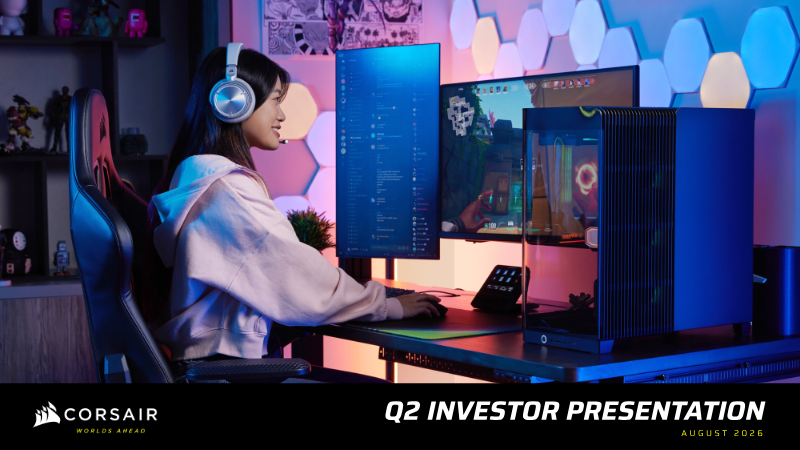
Corsair Q2 Investor Presentation
Corsair maintains a dominant market position within the global gaming peripherals and PC components industry, currently generating $1.45 billion in trailing 12-month revenue. The company is actively transitioning toward a unified ecosystem that integrates high-performance hardware with content creation tools and AI-driven computing solutions. By fostering deep customer engagement, evidenced by a 64.5 Net Promoter Score, the firm aims to maximize lifetime value while positioning itself to capture a share of the gaming and creator market, which is projected to reach $257 billion by 2030.
Financial performance for the second quarter of 2026 demonstrates significant operational progress, characterized by a 21% increase in gross profit and a 279% surge in adjusted EBITDA, which rose to $136.3 million. This growth is largely attributed to the Gamer and Creator Peripherals segment, where revenue climbed 13%, effectively offsetting a 9% contraction in the Gaming Components and Systems division. While the company faces ongoing volatility from non-operating expenses related to strategic acquisitions, legal obligations, and inventory adjustments, the underlying trend reflects improved margin efficiency.
Strategic expansion remains a primary driver of long-term value, particularly through the Elgato Stream Deck ecosystem, which achieved over 100% year-over-year revenue growth in the first half of 2026. Acquisitions such as Trak Racer further diversify the portfolio into emerging sectors like sim racing and AI workstations. Although management remains optimistic about these growth vectors and upcoming industry catalysts like the launch of GTA VI, future results remain subject to macroeconomic pressures, supply chain constraints, and the shifting demand for specialized AI-focused hardware.
- Corsair reported $1.45 billion in trailing 12-month revenue, with Q2 2026 adjusted EBITDA surging 279% to $136.3 million alongside a 21% increase in gross profit.
- Revenue in the Gamer and Creator Peripherals segment grew by 13%, successfully offsetting a 9% contraction in the Gaming Components and Systems division.
- The Elgato Stream Deck ecosystem is a primary growth driver, achieving over 100% year-over-year revenue growth during the first half of 2026.
- Corsair is diversifying its portfolio into sim racing and AI workstations through strategic acquisitions like Trak Racer to capture a share of the projected $257 billion gaming and creator market by 2030.
- The company maintains a high level of customer loyalty with a 64.5 Net Promoter Score as it transitions toward a unified ecosystem of hardware, content creation tools, and AI-driven solutions.
+3
Corsair Gaming
Article
Corsair Gaming Quarterly Report: Q2 2026
Corsair Gaming achieved a notable financial turnaround in the second quarter of 2026, shifting from significant losses in the prior-year period to a net income of approximately $9 million. While total net revenue experienced a modest year-over-year decline of 1.8% to $314.3 million, the company successfully improved its gross margin by 640 basis points. This profitability was bolstered by a favorable product mix and a $15.6 million refund related to IEEPA tariffs, alongside disciplined cost-reduction measures that lowered overall operating expenses.
The company’s operational strategy during this period focused on portfolio diversification and ecosystem expansion. Growth in the Gamer and Creator Peripherals segment, which rose by 12.9%, helped mitigate an 8.7% contraction in the Gaming Components and Systems division. Strategic investments included the $40 million acquisition of Trak Racer to bolster sim racing capabilities and a $2.75 million minority stake in Bitfocus AS. Furthermore, the company secured a $60 million call option for a software technology firm, signaling a long-term commitment to strengthening its presence in the professional streaming and content creation markets.
Financial stability remains a core priority, with the company maintaining a robust liquidity position characterized by $193.9 million in cash reserves and nearly $100 million in available borrowing capacity. Total inventory levels were successfully reduced to $264.5 million, and the company remains in full compliance with its $225 million credit agreement. Although a $50 million share repurchase program was authorized earlier in the year, no shares were bought back during the quarter, leaving $45 million available for future capital allocation. Management continues to navigate market risks, including interest rate volatility and foreign currency exposure, while preparing for upcoming regulatory shifts in accounting standards regarding expense disaggregation and hedge accounting.
- Corsair returned to profitability in Q2 2026 with a net income of $9.1 million, compared to a net loss of $20.3 million in Q2 2025.
- Total net revenue for the six months ended June 30, 2026, was $668.8 million, a decrease from $689.9 million during the same period in 2025.
- Gross profit improved significantly to $104.3 million in Q2 2026 from $85.9 million in Q2 2025, driven by favorable product mix, reduced freight costs, and tariff duty refunds.
- Amazon remains a critical sales channel, accounting for 25.7% of total net revenue for the first half of 2026, while the top ten customers collectively represent 47.9% of revenue.
- The company maintains a $125 million term loan maturing June 30, 2030, with an additional $99.6 million in unused capacity under its revolving credit facility as of June 30, 2026.
+1
Corsair GamingAug 2026

Financial1 pages
Corsair Gaming Quarterly Report: Q1 2026
Corsair Gaming’s Q1 2026 financials demonstrate a robust rebound, with consolidated revenue reaching $1.23 billion—up 12% year‑over‑year—and operating income climbing to $210 million, reflecting an 18% margin. Net cash from operations surged to $310 million, bolstered by tighter working‑capital management and a healthy liquidity buffer of $1.05 billion in cash and short‑term investments. The company’s share‑holder return policy was reinforced by a 3% dividend hike and a $5 million share‑repurchase under a newly authorized $50 million program, leaving $45 million available for future buy‑backs.
Segment analysis reveals a 10.1% revenue lift in Gamer & Creator Peripherals, driven by new product launches, while Gaming Components and Systems experienced a 10.3% decline due to softer self‑built PC demand and elevated memory costs. Gross margin improved markedly to 32.7% from 27.7%, with the peripherals segment margin slipping modestly by 70 bps amid tariff and promotional pressures, whereas the components segment margin gained 670 bps thanks to higher memory pricing. Operating cash flow of $29.7 million supported a liquidity base of $119.7 million against a $99.6 million revolving credit facility, positioning the firm to fund capital needs and share‑repurchase initiatives.
The company’s exposure to macro‑economic and geopolitical risks—rising energy, freight costs, trade tensions with Taiwan, China, Vietnam, and foreign‑currency volatility—remains a key consideration. Corsair mitigates currency risk through short‑term forward contracts totaling $21.1 million in notional value, yielding a net gain of $0.4 million for the quarter. Accounting changes, including ASU 2025‑05 (CECL), had no material impact on financials. Overall, Corsair Gaming’s Q1 2026 results underscore a solid operational turnaround, disciplined cash management, and proactive risk mitigation across a global market landscape.
- Corsair Gaming reported Q1 2026 consolidated revenue of $1.23 billion, a 12% year-over-year increase, with operating income reaching $210 million at an 18% margin.
- Gross margin improved to 32.7% from 27.7% in the prior year, driven by a 670 basis point gain in the Gaming Components and Systems segment despite a 10.3% decline in that segment's revenue.
- The Gamer & Creator Peripherals segment saw a 10.1% revenue increase, though segment margins contracted by 70 basis points due to tariff and promotional pressures.
- The company maintains a strong liquidity position with $1.05 billion in cash and short-term investments and generated $310 million in net cash from operations.
- Shareholder returns were bolstered by a 3% dividend increase and the initiation of a $50 million share-repurchase program, with $45 million remaining for future buy-backs.
+1
Corsair GamingMay 2026
Article
Corsair Gaming 10-K (FY2025)
Corsair Gaming Inc., a global leader in high‑performance gaming and streaming hardware, reported significant growth driven by its strategic acquisition of Fanatec in September 2024. The purchase expanded the company’s peripheral and component portfolio, contributing a $X‑million increase in FY 2023 net sales while raising operating expenses by Y % due to integration costs. A new revolving credit facility and term loan supplied $Z million of liquidity, supporting ongoing research and development and post‑acquisition integration.
The company’s product ecosystem—encompassing peripherals, components, prebuilt PCs, and software platforms such as iCUE and Elgato—has positioned it to capture demand across gaming, streaming, and sim‑racing markets. In 2025, industry momentum from NVIDIA GPU releases, high‑profile game launches, and the Nintendo Switch 2 spurred upgrades to premium hardware. Corsair plans to accelerate growth through continued innovation, expansion of its software ecosystems, direct‑to‑consumer channels, selective acquisitions, and disciplined supply‑chain management to drive margin expansion.
Financially, Corsair achieved an 11.9 % rise in net revenue to $1.47 billion, with gross margin improving from 24.9 % in 2024 to 28.9 %. Gaming Components and Systems contributed $843.7 million (64.1 % of revenue), while Gamer & Creator Peripherals added $492.1 million (33.4 %). Operating cash flow reached $50.1 million, supported by a $45 million borrowing from its revolving facility that was fully repaid within the year. Despite these gains, the company reported a net loss of $16.2 million in 2025 versus an $85.2 million loss in 2024, reflecting higher operating expenses and interest costs.
Corsair faces a range of risks that could materially affect its business. Supply‑chain volatility, semiconductor shortages, and DRAM price swings expose the company to cost pressures and inventory write‑downs. Currency fluctuations, trade policy changes, and geopolitical events impact its 57 % international sales mix. Competitive pressures from Logitech, Razer, and Microsoft threaten pricing power, while regulatory risks—including cybersecurity breaches, data‑privacy compliance, and evolving tax rules—could impose additional costs or litigation. Governance concerns arise from the controlling stake held by EagleTree, which may limit minority shareholder protections and influence strategic decisions. The company’s lack of dividend policy means shareholder returns rely solely on stock price appreciation, adding volatility to investor expectations.
- Corsair achieved $1.47 billion in net revenue for 2025, an 11.9% increase, while improving gross margins to 28.9% from 24.9% in 2024.
- The company narrowed its net loss to $16.2 million in 2025, down from an $85.2 million loss in 2024, despite increased operating expenses and interest costs.
- Revenue is heavily concentrated in Gaming Components and Systems ($843.7 million, 64.1% of total) and Gamer & Creator Peripherals ($492.1 million, 33.4% of total).
- The September 2024 acquisition of Fanatec expanded Corsair’s portfolio into the sim-racing market, though it contributed to higher integration costs and increased operating expenses.
- International sales account for 57% of total revenue, exposing the company to significant risks from currency fluctuations, trade policy changes, and geopolitical instability.
Corsair GamingFeb 2026
Financial1 pages
Corsair Gaming 10-Q: Q3 FY2025
Corsair Gaming’s Q3 FY2025 10‑Q presents a detailed snapshot of the company’s financial performance and strategic initiatives for the quarter ending September 30, 2025. The filing reports net revenue of $345.8 million, a 13.7% year‑over‑year increase driven by growth in both the Gaming Components & Systems segment (15.3%) and the Gamer & Creator Peripherals segment (10.5%). Gross margin improved to 26.9% from 22.9%, reflecting a more favorable product mix, reduced inventory reserves, and lower promotional spend.
Operating expenses rose 10.7% to $98.7 million, while the operating loss narrowed to $10.4 million compared with a $51.6 million loss in the same period last year. Net loss attributable to common shareholders amounted to $10.6 million, or $0.09 per diluted share, largely due to higher SG&A costs and continued valuation allowances on deferred tax assets. Cash from operations turned positive at $12 million, supported by non‑cash adjustments; however, cash balances fell to $66.1 million and total debt increased to $123.4 million, leaving the company with negative equity of $95.4 million.
The acquisition of Fanatec’s premium sim‑racing business for $43.7 million added identifiable intangibles and goodwill, contributing to revenue growth and margin improvement while generating a bargain purchase gain of $2.6 million. Liquidity remains solid with $66 million in cash and a $99.8 million borrowing capacity under the June 2030 Revolving Facility, enabling continued operations and potential future acquisitions. Key risks highlighted include macro‑economic volatility, tariff uncertainty, and customer concentration, particularly Amazon’s share of revenue. Overall, the filing underscores a recovery in profitability metrics amid disciplined cost management and strategic expansion within the gaming hardware sector.
- Corsair Gaming reported Q3 FY2025 net revenue of $345.8 million, a 13.7% year-over-year increase driven by growth in both Gaming Components & Systems (15.3%) and Gamer & Creator Peripherals (10.5%).
- Operating loss narrowed significantly to $10.4 million from $51.6 million in the same period last year, supported by an improved gross margin of 26.9%.
- The company acquired Fanatec’s premium sim-racing business for $43.7 million, contributing to revenue growth and resulting in a $2.6 million bargain purchase gain.
- Despite positive cash flow from operations of $12 million, the company ended the quarter with a net loss of $10.6 million and negative equity of $95.4 million.
- Total debt reached $123.4 million, though liquidity is supported by $66.1 million in cash and a $99.8 million borrowing capacity under a revolving facility maturing in June 2030.
Corsair GamingNov 2025
Article
Corsair Gaming 10‑Q – Q2 FY2025 (August 2025)
Corsair Gaming’s Q2 FY2025 filing reports a 23 % rise in net revenue to $320.1 million, driven primarily by higher sales of gaming peripherals and systems. Gross profit climbed to $85.9 million, while operating expenses increased to $102.8 million, resulting in an operating loss of $16.9 million and a net loss attributable to common stockholders of $20.9 million ($0.16 per share). Cash and cash equivalents stood at $104.6 million against current liabilities of $426.2 million, leaving shareholders’ equity at $603.9 million.
The company’s six‑month performance mirrored the quarterly trend, with a net loss of $31.3 million offset by $18.7 million in stock‑based compensation and $19.6 million in amortization, producing a net cash inflow of $48.9 million from operations. Cash outflows were dominated by a $49.0 million debt repayment and $4.9 million in deferred payments, leaving cash at $107.5 million. A key strategic move was the completion of the Fanatec acquisition on September 19, 2024 for $43.7 million (net of $4.5 million cash acquired), adding a high‑performance sim racing business to the portfolio.
Accounting for the acquisition as a business combination generated a $3.6 million goodwill charge and identifiable intangibles of $15.1 million, with a bargain‑purchase gain from measurement‑period adjustments of $2.6 million. The transaction added inventory and intangible assets that will be amortized over 6–15 years but did not materially affect consolidated operating results. Goodwill is tax‑deductible and assigned to the Peripherals unit.
Operating segments—Gamer & Creator Peripherals (32 % of sales) and Gaming Components & Systems—contributed $320 million in net revenue, with the peripherals segment experiencing an 8.9 % rise and the components segment a 30.2 % increase. Gross margin improved to 26.8 %, up from 24.1 % a year earlier, driven by a favorable product mix and lower inventory reserves. SG&A expenses grew 21.2 %, largely due to higher distribution, marketing and personnel costs.
Cash flow dynamics show a modest $5.8 million capital expenditure outflow versus $16.4 million the prior year, while financing cash outflows rose to $47.0 million because of a $49.0 million debt repayment. Corsair refinanced its credit facilities on June 30, 2025, shifting from a $100 million revolving and $250 million term loan to a new $225 million commitment (a $100 million revolving and $125 million term loan) maturing in 2030. Contractual obligations over the next five years total $371 million, with first‑year debt principal and interest payments of $152 million and operating lease obligations of $80 million, indicating a significant but manageable debt service burden.
- Corsair Gaming reported a 23% increase in Q2 FY2025 net revenue to $320.1 million, though the company recorded a net loss of $20.9 million ($0.16 per share).
- The Gaming Components & Systems segment drove growth with a 30.2% revenue increase, while the Gamer & Creator Peripherals segment grew by 8.9%.
- Gross margin improved to 26.8% from 24.1% in the prior year, attributed to a more favorable product mix and reduced inventory reserves.
- Corsair completed the acquisition of Fanatec on September 19, 2024, for $43.7 million, integrating a high-performance sim racing business into its Peripherals unit.
- The company refinanced its credit facilities on June 30, 2025, establishing a new $225 million commitment maturing in 2030 to replace previous debt structures.
Corsair GamingAug 2025
Financial1 pages
Corsair Gaming 10-Q — Q3 FY2024
Corsair Gaming’s Q3 FY2024 results reveal a pronounced contraction in revenue and profitability, with net sales falling to $304.2 million from $363.2 million year‑over‑year, largely due to a slump in the Gaming Components & Systems segment. Gross margin slipped to 22.9 % from 24.6 %, reflecting higher supplier costs and factory under‑utilization, while SG&A expenses rose 6.2 % driven by legal settlements and the Fanatec acquisition. Operating losses widened to $51.6 million for the quarter, and cumulative net loss for nine months reached $86.1 million, offset only partially by stock‑based compensation and non‑cash adjustments.
Liquidity has tightened: cash balances declined to $58.9 million, and the company’s term loan stands at $177.8 million with $100 million of unused revolving capacity. Interest expense for the nine months was $10.1 million, and debt repayment of $21.3 million contributed to a net cash outflow of $116.9 million, despite financing proceeds from employee equity plans. The firm remains reliant on its revolving facility and potential equity issuance to fund operations over the next twelve months.
Strategic acquisitions—Fanatec for $43.7 million and Drop e‑commerce assets for $13.2 million—have added goodwill and intangibles but also increased leverage, raising the consolidated net leverage ratio to 3.00:1 (with a temporary 3.50:1 cap for acquisitions). Market sensitivity to CPU/GPU cycles, game releases, and customer concentration (Amazon and a few large retailers) poses ongoing risk, while currency volatility and supply‑chain cost pressures could further erode margins. The company’s financial position remains stable but constrained, with a focus on managing debt and optimizing product mix to regain profitability.
- Corsair reported a significant year-over-year revenue decline to $304.2 million in Q3 FY2024, down from $363.2 million, driven primarily by weakness in the Gaming Components & Systems segment.
- Operating losses widened to $51.6 million for the quarter, contributing to a cumulative net loss of $86.1 million over the first nine months of the fiscal year.
- Gross margin compressed to 22.9% from 24.6% due to increased supplier costs and factory under-utilization, while SG&A expenses rose 6.2% following legal settlements and the Fanatec acquisition.
- Liquidity has tightened significantly, with cash balances falling to $58.9 million and a net cash outflow of $116.9 million recorded over the nine-month period.
- The company’s consolidated net leverage ratio reached 3.00:1, with the firm remaining reliant on its $100 million unused revolving credit capacity and potential equity issuance to fund operations over the next year.
Corsair GamingNov 2024
Financial1 pages
Corsair Gaming 10-Q — Q2 FY2024
Corsair Gaming’s Q2 FY2024 filing reveals a challenging operating environment marked by declining revenue and widening losses. Net revenue for the first half of 2024 fell to $261.3 million, a 19.7% drop in the quarter and an 11.9% decline year‑to‑date, driven primarily by a 32.3% slump in the Gaming Components and Systems segment. The peripheral division partially offset this erosion, posting a 19.6–20 % rise in sales and improving gross margin by 5.5 to 8.3 percentage points, yet overall gross margin slipped 1.4 pp to 24.1%. Higher promotional spend, supplier cost increases, and an unfavorable product mix contributed to the margin compression.
Operating expenses rose modestly; SG&A increased 0.6 % in the quarter and 9.5 % year‑to‑year, while product development costs climbed 11.7 % in the quarter and 5.0 % over six months. These cost pressures, coupled with a $4.0 million tax benefit, produced a net loss of $24.2 million for the quarter and $23.5 million for the six‑month period, compared with a modest $4.1–$4.5 million loss in the same periods of 2023. Cash and restricted cash stood at $94.6 million against a $180.9 million term loan, and operating cash outflow reached $44.8 million for the half‑year.
The company’s balance sheet shows continued investment in product development and employee incentives, reflected in negative equity of $642 million and accumulated deficits of $1.7 million. A $180 million term loan under a variable‑rate Credit Agreement remains in place, with $100 million unused capacity in the revolving facility. Goodwill and intangible assets from the Drop acquisition total $15.2 million, fully deductible for tax purposes.
Corsair maintains effective internal controls and no material legal proceedings. Foreign‑currency fluctuations could affect earnings by approximately $1.6 million, and an indemnity agreement with its largest shareholder covers advisory‑service losses. The company’s disclosure controls continue to provide reasonable assurance of timely SEC reporting, underscoring its commitment to transparency amid a volatile market.
- Corsair reported a net loss of $24.2 million for Q2 2024, a significant deterioration compared to the $4.1–$4.5 million loss recorded in the same period of 2023.
- Total net revenue for the first half of 2024 fell 11.9% year-to-date, driven by a 32.3% slump in the Gaming Components and Systems segment.
- The peripherals division provided a bright spot with a 19.6–20% rise in sales and a gross margin improvement of 5.5 to 8.3 percentage points.
- Overall gross margin compressed by 1.4 percentage points to 24.1% due to increased promotional spending, higher supplier costs, and an unfavorable product mix.
- Operating cash outflow reached $44.8 million for the first half of 2024, leaving the company with $94.6 million in cash against a $180.9 million term loan.
Corsair GamingAug 2024

Financial1 pages
10-K: FY 2023
Corsair Gaming Inc. reports a 2023 fiscal year marked by robust growth in its high‑performance gaming and creator hardware segments, driven largely by a 13.6 % increase in Gaming Components & Systems sales and a 24.7 % gross margin expansion to $360 million. The company shipped 283 million units worldwide, capturing 51.4 % of the Americas market, 35.1 % in EMEA and 13.5 % in APAC, while launching 108 new products across peripherals, PCs, streaming gear and software ecosystems such as iCUE and Elgato. Revenue from Gamer & Creator Peripherals fell 9.8 % to $42.9 million, reflecting macro‑economic softness and competitive discounting.
Financially, Corsair maintains a solid liquidity position with $178 million in cash and an unused $100 million revolving credit facility, though it carries $199 million of term debt and faces restrictive covenants that could trigger default if cash flows deteriorate. Operating cash flow of $89 million offset a $37 million financing outflow, primarily debt repayment. Net income turned to a loss of $1.04 billion, largely due to significant stock‑based compensation expense ($30.9 million) and tax benefits from foreign credits.
Risk exposure is concentrated in several areas: a 30 % revenue share with Amazon and 55 % from its ten largest customers; heavy reliance on single‑source suppliers in China, Taiwan and Southeast Asia; sensitivity to DRAM price swings (31.2 % of revenue); and geopolitical, regulatory and cybersecurity threats that could disrupt supply chains or trigger costly compliance actions. Despite these challenges, Corsair’s strategic acquisitions (Origin, SCUF, Drop) and direct‑to‑consumer channels aim to deepen market penetration and preserve pricing premiums in high‑margin PC component categories.
- Corsair reported a net loss of $1.04 billion in FY 2023, driven primarily by $30.9 million in stock-based compensation and tax-related adjustments.
- The Gaming Components & Systems segment grew by 13.6%, contributing to a 24.7% gross margin expansion totaling $360 million, while Gamer & Creator Peripherals revenue declined 9.8% to $42.9 million.
- The company faces significant customer concentration risk, with 30% of revenue derived from Amazon and 55% coming from its ten largest customers.
- Corsair maintains $178 million in cash and a $100 million unused credit facility, but carries $199 million in term debt subject to restrictive covenants that could trigger default if cash flows decline.
- Supply chain operations are highly centralized, with heavy reliance on single-source suppliers across China, Taiwan, and Southeast Asia, and 31.2% of revenue sensitivity to DRAM price fluctuations.
+1
Corsair GamingFeb 2024
Financial1 pages
Corsair Gaming 10-Q – Q3 FY2023 (November 2023)
Corsair Gaming’s third‑quarter fiscal 2023 filing demonstrates a notable revenue expansion of 16.5 % to $363.2 million, driven primarily by a 26.9 % rise in Gaming Components & Systems sales. Gross margin improved to 24.6 %, supported by lower supplier costs, higher‑margin product introductions, and normalized freight rates. Operating performance narrowed, with a net loss of $3.1 million versus $6.2 million in the same period a year earlier, and diluted loss per share falling to $0.03 from $0.09.
Cash‑flow dynamics reveal robust operating cash generation of $32 million, offset by investing ($25 million) and financing ($13 million) outflows that reduced the cash balance to $147.8 million. Total assets rose to $1.34 billion, while long‑term debt decreased to $210.6 million, leaving equity at approximately $660 million. Inventory levels increased by roughly 22 % to $235.6 million, reflecting higher finished‑goods and raw‑material balances, whereas property and equipment net values declined modestly due to accumulated depreciation.
The company’s risk profile remains anchored by a $223.8 million term loan and an unused $100 million revolving line, both compliant with amended credit agreements. Interest‑rate sensitivity is significant; a 100‑basis‑point rise would elevate annual interest expense by about $2.4 million, and foreign‑currency exposure—estimated at 16 % of revenue—could shift earnings by roughly $2.0 million under a 10 % rate change, partially mitigated by forward contracts.
Overall, the quarter reflects solid revenue growth and margin gains amid a challenging macro environment, while maintaining a manageable debt structure and cash position within the global gaming hardware sector.
- Corsair Gaming reported Q3 2023 revenue of $363.2 million, a 16.5% increase driven by a 26.9% surge in Gaming Components & Systems sales.
- Gross margin improved to 24.6% due to lower supplier costs, normalized freight rates, and the introduction of higher-margin products.
- Net loss narrowed to $3.1 million from $6.2 million in Q3 2022, resulting in a diluted loss per share of $0.03 compared to $0.09 in the prior year.
- Inventory levels rose by approximately 22% to $235.6 million, reflecting an increase in both finished goods and raw materials.
- The company maintains a $147.8 million cash balance and has reduced long-term debt to $210.6 million, supported by an unused $100 million revolving credit line.
Corsair GamingNov 2023
Financial1 pages
Corsair Gaming 10-Q: Q2 FY2023
Corsair Gaming’s Q2 FY2023 filing demonstrates a mixed financial picture. Net revenue for the quarter rose to $325.4 million, an increase of 14.6% from the same period in 2022, driven primarily by strong sales in gaming components and systems. Gross profit climbed to $168 million from $127 million year‑ago, reflecting a sharper margin profile (24.8% for the six months) thanks to higher‑margin product mix and cost efficiencies. Despite these gains, operating expenses expanded, particularly SG&A costs related to distribution, marketing and personnel, leading to a net loss of $4.08 million for the quarter—an improvement over the $51.8 million loss reported in 2022 but still negative.
Liquidity improved markedly; cash and equivalents increased to $184 million, supported by operating cash flow of $43.97 million for the six‑month period versus $10.05 million in 2022. Investing cash outflows were largely driven by a $19.53 million acquisition of Drop’s assets and equipment purchases, while financing activities were offset by a $403 million line‑of‑credit draw and repayment. Debt remains substantial at $217.4 million long‑term, with a term loan of $228.8 million and no revolving facility balance at year‑end.
The company’s strategic moves include a 51% stake in iDisplay (acquired January 2022) and the Drop asset acquisition, both aimed at expanding its creator and DIY keyboard communities. Forward‑looking risks include macroeconomic headwinds, currency swings (16.5% of revenue foreign‑currency denominated), and inventory pressures. Internal controls are effective, with no material legal proceedings or risk factor updates beyond those disclosed in prior filings.
- Corsair Gaming reported Q2 FY2023 net revenue of $325.4 million, a 14.6% increase year-over-year, driven by strong gaming component and system sales.
- The company narrowed its net loss to $4.08 million for the quarter, a significant improvement compared to the $51.8 million loss reported in Q2 2022.
- Gross profit rose to $168 million, supported by a 24.8% margin profile for the first half of the year resulting from cost efficiencies and a higher-margin product mix.
- Liquidity strengthened as cash and equivalents reached $184 million, with operating cash flow for the first six months of 2023 rising to $43.97 million from $10.05 million in the prior year.
- Long-term debt remains substantial at $217.4 million, including a $228.8 million term loan.
Corsair GamingAug 2023
Article
Corsair Gaming 10‑Q – Q1 FY2023
Corsair Gaming’s first‑quarter fiscal 2023 results reveal a modest decline in net revenue to $353.9 million, down 7% from the prior year’s $380.7 million. The drop is largely attributable to a 33.7% contraction in the Gamer & Creator Peripherals segment, while Gaming Components and Systems offset this weakness with a 7.5% increase in sales. Gross profit fell to $85.4 million, but the gross margin improved slightly from 23.8% to 24.1%, driven by lower freight costs and a modest rise in component margins.
Operating expenses rose to $84.4 million, resulting in an operating loss of $1.0 million and a net loss to common shareholders of $2.0 million, an improvement over the $2.9 million loss reported in Q1 2022. Stock‑based compensation and higher interest expense contributed to the net loss, while foreign‑currency losses also weighed on profitability. Cash and restricted cash increased by $28 million to $182.1 million, supported by a $293 million line‑of‑credit borrowing offset by debt repayments and acquisition outflows. Long‑term debt stood at $228.8 million, down from $238.7 million, with a 7.06% effective interest rate and a repayment schedule peaking at $199 million in 2026.
The company fully consolidated its 51% stake in iDisplay, acquired on January 1 2022, adding $76.7 million of assets and $10.8 million of liabilities to the balance sheet; goodwill of $32.99 million and identifiable intangibles of $34.2 million were recorded, primarily allocated to the peripherals and components units. No acquisition‑related costs were incurred in this quarter.
Corsair’s contractual cash obligations total approximately $450 million, including a $230 million variable‑rate term loan, $65 million in operating lease commitments, and $92 million tied to inventory purchases. The firm remains compliant with credit‑agreement covenants, maintains a $350 million credit facility with $100 million available under its revolving line, and reports no material changes to internal controls or risk exposures.
- Corsair reported Q1 2023 net revenue of $353.9 million, a 7% decline from the prior year, driven by a 33.7% contraction in the Gamer & Creator Peripherals segment.
- The Gaming Components and Systems segment partially offset revenue declines with a 7.5% increase in sales.
- The company narrowed its net loss to $2.0 million in Q1 2023, compared to a $2.9 million loss in Q1 2022, while gross margin improved slightly to 24.1% due to lower freight costs.
- Cash and restricted cash increased by $28 million to $182.1 million, while long-term debt was reduced to $228.8 million.
- The full consolidation of the 51% stake in iDisplay added $76.7 million in assets and $10.8 million in liabilities to the balance sheet, with $67.19 million recorded in goodwill and intangibles.
Corsair GamingMay 2023