Comscore
Research11 documents
Documents

Article
Insights: Multi-Platform
The provided material serves as a central repository for cross-platform media measurement and industry intelligence, focusing on how evolving technologies like artificial intelligence and creator-led content are reshaping consumer behavior. The primary thesis emphasizes the necessity of integrated, multi-platform analytics to understand modern audience engagement across digital, television, and streaming environments. By tracking metrics such as Connected TV (CTV) service performance, mobile app usage, and box office results, the platform provides a comprehensive view of the current media landscape.
Key data points highlight the dominance of major tech entities like Alphabet and Microsoft in multi-platform and online video properties as of mid-2026. The content also tracks specific engagement trends, such as the "TV Stickiness Index" for broadcast series and the ranking of top CTV services, led by Netflix, YouTube, and Amazon Prime Video. These insights are designed to assist stakeholders in sectors ranging from retail and finance to gaming and automotive, enabling them to navigate shifting consumer journeys and optimize advertising effectiveness.
The scope of this intelligence is global, covering diverse markets and industry segments through 2026. The methodology relies on continuous data collection and measurement across various digital and traditional media channels, synthesized into rankings, whitepapers, and strategic blog analysis. By offering tools for programmatic targeting and content addressability, the platform facilitates a data-driven approach to marketing, helping businesses adapt to the increasing influence of AI assistants and the changing architecture of modern media measurement.
- AI assistants are fundamentally shifting consumer behavior by outsourcing significant portions of the purchase journey, necessitating a new approach to marketing and intent measurement.
- Comscore has entered a strategic partnership with Amazon DSP to expand content addressability and improve campaign performance measurement.
- The company is expanding its audio measurement capabilities through transcript-level targeting in collaboration with partners including Spotify, SiriusXM, Triton Digital, Acast, and Libysn.
- Comscore reported its second-quarter 2026 financial results on August 12, 2026, alongside the announcement of a new ROI-focused business transformation strategy.
- As of mid-August 2026, the top-performing domestic box office film was 'Spider-Man: Brand New Day,' followed by 'The Odyssey' and 'The End of Oak Street.'
+1
Comscore

Article
Insights: Coronavirus
The provided material serves as a digital repository for industry analysis, focusing on media consumption trends, advertising effectiveness, and market performance metrics. The primary objective is to provide stakeholders with actionable intelligence regarding audience behavior across digital, television, and cinematic platforms. By aggregating data on consumer engagement, the platform aims to assist businesses in navigating shifting market landscapes, including the integration of artificial intelligence into the consumer journey and the evolution of cross-platform measurement.
Key findings highlight the rapid transformation of discovery and intent within the content ecosystem, particularly as AI assistants increasingly influence purchasing decisions. Performance data as of mid-2026 underscores the dominance of major digital properties such as Alphabet and Microsoft, alongside the continued relevance of streaming services like Netflix and YouTube in the connected television (CTV) space. Box office performance and television engagement metrics are tracked regularly, providing a snapshot of current media consumption habits.
The scope of this intelligence covers global markets with a specific emphasis on the United States, spanning the period through August 2026. The methodology relies on proprietary measurement tools that track multi-platform audiences, smartphone app usage, and box office results. These insights are disseminated through a combination of blog posts, whitepapers, and industry rankings, which collectively offer a comprehensive view of how modern media consumption and advertising strategies are adapting to technological advancements and changing consumer preferences.
- As of July 2026, Alphabet, Microsoft Sites, and The Walt Disney Company lead the market as the top multi-platform properties.
- Netflix, YouTube, and Amazon Prime Video are the top three Connected TV (CTV) services as of June 2026.
- Alphabet, Comcast-NBCUniversal, and Paramount Global rank as the leading U.S. online video properties as of June 2026.
- YouTube, Google Search, and Gmail hold the top three positions for smartphone app usage as of July 2026.
- Comscore entered a partnership with Amazon DSP on June 24, 2026, to expand content addressability and campaign performance measurement.
+1
Comscore

Article
Branded Content
The provided content serves as a digital repository for industry insights, research, and performance metrics managed by Comscore. The primary purpose of this platform is to provide stakeholders across various sectors—including gaming, digital media, retail, and entertainment—with data-driven intelligence regarding audience behavior, advertising effectiveness, and market trends. By aggregating cross-platform measurement tools, the resource aims to assist organizations in optimizing their marketing strategies and understanding the evolving digital landscape.
Key findings and data points are presented through regular updates on multi-platform properties, connected TV (CTV) service rankings, and box office performance. As of August 2026, the data highlights the dominance of major tech entities like Alphabet and Microsoft in digital engagement, alongside shifting consumer preferences in streaming and mobile application usage. The platform emphasizes the transformative impact of artificial intelligence and content creators on the modern consumer journey, noting that AI assistants are increasingly influencing purchase intent and discovery.
The scope of this information is global, covering diverse industry segments such as automotive, financial services, pharmaceuticals, and gaming. The methodology relies on proprietary measurement technologies that track audience engagement across television, digital, and social media channels. By offering a mix of real-time rankings, whitepapers, and expert commentary, the platform functions as a comprehensive analytical hub for navigating the complexities of modern media consumption and advertising addressability.
- AI assistants are fundamentally altering the consumer purchase journey by shifting how intent is expressed and discovery occurs in the content ecosystem.
- Comscore has launched transcript-level targeting and measurement for audio advertising in partnership with Spotify, SiriusXM, Triton Digital, Acast, and Libysn as of July 22, 2026.
- A partnership with Amazon DSP was established on June 24, 2026, to expand content addressability and improve campaign performance measurement.
- Comscore announced a new ROI-focused business transformation strategy on August 11, 2026, followed by the release of their second-quarter 2026 financial results on August 12, 2026.
- As of the weekend ending August 16, 2026, 'Spider-Man: Brand New Day' holds the top position in both domestic and worldwide box office rankings.
+1
Comscore

Article
Coronavirus
The global COVID-19 pandemic significantly altered consumer behavior, forcing a fundamental shift in how audiences interact with media, advertising, and digital services. This analysis tracks these evolving consumption trends across various industry sectors, providing a comprehensive view of the pandemic's long-term impact on digital engagement and market recovery.
Key findings highlight the acceleration of digital transformation, particularly within the connected TV (CTV) landscape and the surge in digital payment usage driven by the growth of online food delivery services. The automotive and travel sectors experienced distinct recovery patterns, with research identifying the primary factors influencing their stabilization. Furthermore, the movie industry faced persistent volatility, as fluctuating infection rates—such as the emergence of the Omicron variant—directly impacted theater attendance and release strategies, despite periods where up to 83% of global cinemas were operational.
The scope of this research covers a broad geographic range, including the United States, the United Kingdom, and the EU5, with additional insights into emerging markets like India. The data spans the period from 2021 through 2022, utilizing a multi-faceted methodology that incorporates box office intelligence, digital audience measurement, and custom research on consumer habits. By synthesizing these diverse data points, the analysis provides a professional assessment of how regional and industry-specific shifts have redefined the modern digital landscape.
- As of March 2021, U.S. advertising spending experienced a 22% year-over-year surge, marking a significant recovery in the first pandemic-era comparison.
- By June 2021, 83% of movie theaters worldwide had reopened, signaling a major shift in the recovery of the theatrical exhibition industry.
- The pandemic accelerated a fundamental transformation in the media landscape, specifically driving increased adoption and strategic shifts across Connected TV (CTV) platforms.
- The surge in online food delivery services during the pandemic acted as a primary catalyst for increased consumer adoption and usage of digital payment methods.
- Marketing and agency executives maintained a focus on regional data throughout 2021, acknowledging that pandemic-related consumer behavior remained highly volatile and subject to rapid change.
+1
Comscore
Article
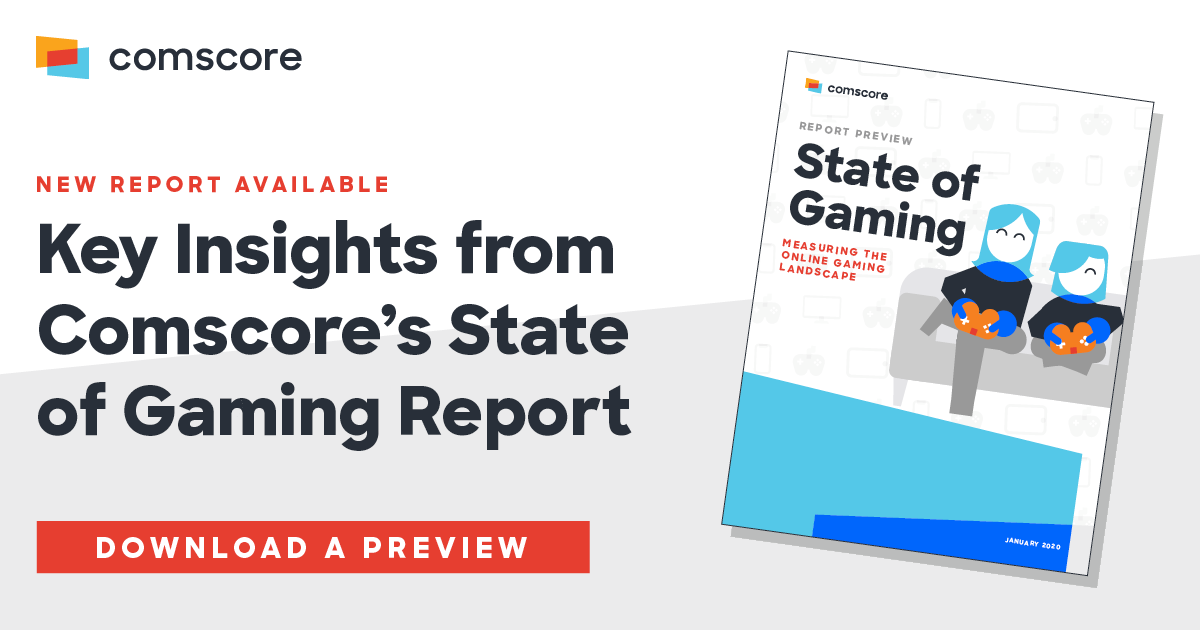
State of Gaming: 2020 Key Insights
The 2020 State of Gaming report serves as a strategic resource for marketers, content owners, and technology companies seeking to navigate the rapidly evolving gaming and esports landscape. Its primary thesis posits that the industry’s accelerated innovation—driven by the emergence of new devices, platforms, and shifting consumer behaviors—has created significant, untapped advertising and commercial opportunities. By analyzing digital gaming audiences, the report aims to provide stakeholders with the actionable intelligence necessary to capitalize on these trends.
The analysis focuses on the intersection of digital media consumption and gaming, highlighting how traditional advertising models are being disrupted by the rise of interactive entertainment. It emphasizes the necessity for industry participants to understand shifting audience engagement patterns across various platforms to maximize marketing effectiveness. The findings are intended to assist organizations in identifying lucrative segments within the gaming ecosystem, moving beyond legacy metrics to capture the value of modern, cross-platform gaming audiences.
While the report functions as a comprehensive industry overview, it specifically targets professionals involved in digital media, advertising, and technology sectors. It provides a foundational look at the state of the industry as of early 2020, offering a framework for evaluating audience behavior in an increasingly fragmented digital environment. By synthesizing data on gaming trends, the report serves as a guide for those looking to align their business strategies with the current realities of the global gaming market.
- The 2020 State of Gaming Report, published by Comscore on February 10, 2020, analyzes the rapid evolution of the gaming and esports sectors.
- The report identifies significant shifts in consumer behavior driven by the emergence of new gaming devices and platforms.
- The findings highlight the development of new advertising opportunities within the gaming ecosystem for marketers and content owners.
- The research provides detailed insights into digital gaming audiences to help tech companies and stakeholders capitalize on market trends.
- The full industry report is available for purchase at a price point of $2,500, with options for custom data modifications.
+3
Comscore
Article
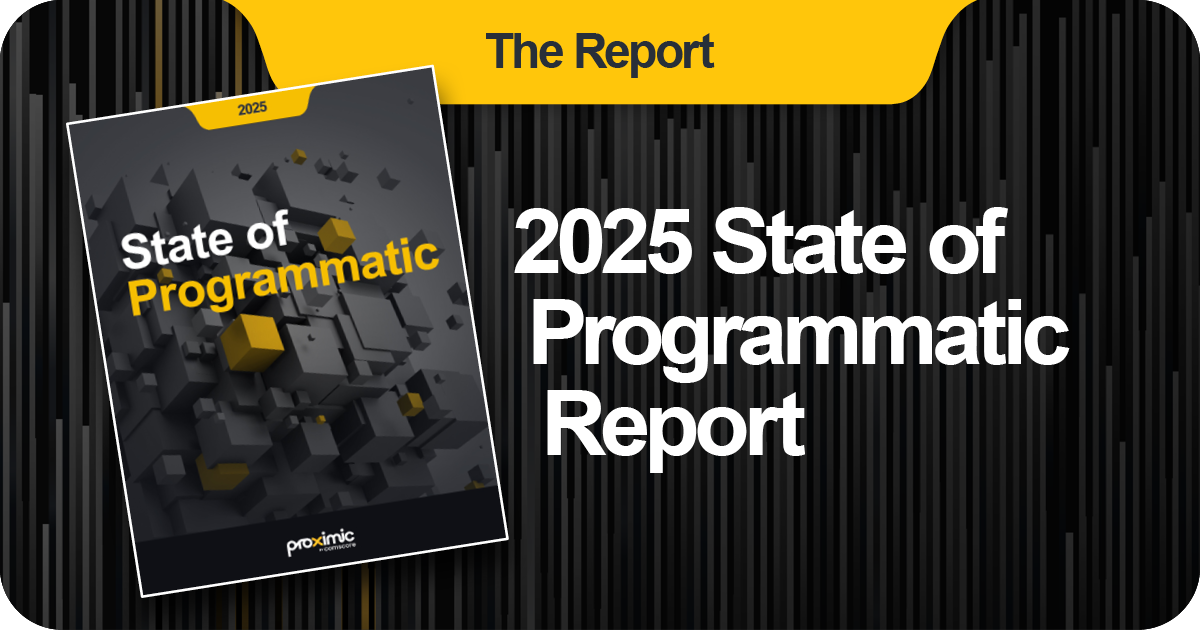
2025 State of Programmatic Report
The 2025 State of Programmatic Report, published by Proximic by Comscore in January 2025, serves as a strategic analysis of the evolving programmatic advertising landscape. The primary thesis centers on the continued expansion of programmatic channels, driven largely by the rapid growth of streaming media and the necessity for marketers to adopt new, privacy-compliant targeting frameworks.
The analysis highlights three critical pillars shaping the industry: the sustained growth of programmatic advertising, the shifting priorities in marketer privacy playbooks, and the increasing migration of advertising budgets toward streaming platforms. By examining these trends, the findings illustrate how programmatic ecosystems are adapting to a digital environment increasingly defined by cross-platform consumption and heightened data privacy requirements.
The scope of the analysis encompasses the broader programmatic advertising industry, focusing on the intersection of digital media, television, and audience activation. The insights are derived from Comscore’s extensive cross-platform media consumption datasets, which include demographic information and television viewership metrics. These data sources enable a comprehensive view of how programmatic tools are utilized to achieve both scale and precision in audience targeting.
Ultimately, the findings emphasize that as consumer behavior shifts toward streaming, programmatic strategies must evolve to maintain effectiveness. The industry is moving toward solutions that balance the need for granular audience insights with the imperative of respecting user privacy, positioning contextual targeting and advanced audience activation as essential components for modern marketing success.
- Programmatic advertising continues to see sustained growth in 2025, driven by evolving channel adoption and shifting media consumption patterns.
- Streaming platforms are increasingly capturing a larger share of advertising budgets, positioning themselves as a primary driver of programmatic investment.
- Marketers are adopting new privacy-focused playbooks to navigate the changing landscape of data collection and audience targeting.
- Contextual targeting solutions are being utilized as a key strategy to maintain scale and precision in advertising campaigns while adhering to user privacy standards.
- Cross-platform data sets, including demographics and TV viewership metrics, are central to modern programmatic audience activation strategies.
+1
Comscore

Article
Box Office
Comscore provides comprehensive global box office measurement and analytics, serving as a primary source for tracking theatrical performance and industry trends. The platform functions as a centralized hub for domestic and international box office data, offering stakeholders actionable insights into movie performance, audience behavior, and market dynamics. By maintaining long-term partnerships with major cinema circuits and providing specialized management systems, the organization supports the operational and analytical needs of the global film industry.
The scope of these insights spans decades of historical data, with a focus on both domestic and international markets. Key analytical outputs include performance rankings, trend analysis, and expert commentary from senior media analysts. Notable data points highlight the industry's recovery and growth, such as the record-breaking $425 million five-day Thanksgiving box office frame and the sustained impact of major theatrical releases. These findings are disseminated through a variety of formats, including video series, podcasts, whitepapers, and infographics, which track milestones such as the $4 billion summer box office threshold.
Methodologically, the platform leverages proprietary tracking technology and direct integrations with theatre management systems to ensure accurate, real-time reporting. By combining quantitative box office metrics with qualitative industry analysis, the service enables exhibitors, distributors, and marketers to evaluate the effectiveness of release strategies and promotional campaigns. The platform’s ongoing commitment to measurement is underscored by its 50-year history in the sector and its continued expansion of multi-year agreements with major theatre chains to provide enterprise-level solutions.
- The theatrical industry experienced a record-breaking 5-day Thanksgiving frame that generated $425 million in revenue, establishing a new performance benchmark for the holiday period.
- Comscore has secured multi-year agreements and five-year extensions for its Cinema ACE and enterprise web solutions with major exhibitors, including Santikos Entertainment, Marcus Theatres, and B&B Theatres.
- The global summer box office has shown signs of a significant revival, tracking toward a $4 billion milestone following the high-profile dual release of Barbie and Oppenheimer.
- Comscore is marking 50 years of movie measurement, having officially celebrated the milestone in April 2026.
- Major animated releases like The Super Mario Bros. Movie have demonstrated strong market potential, with domestic debut projections exceeding $100 million.
Comscore
Legal6 pages
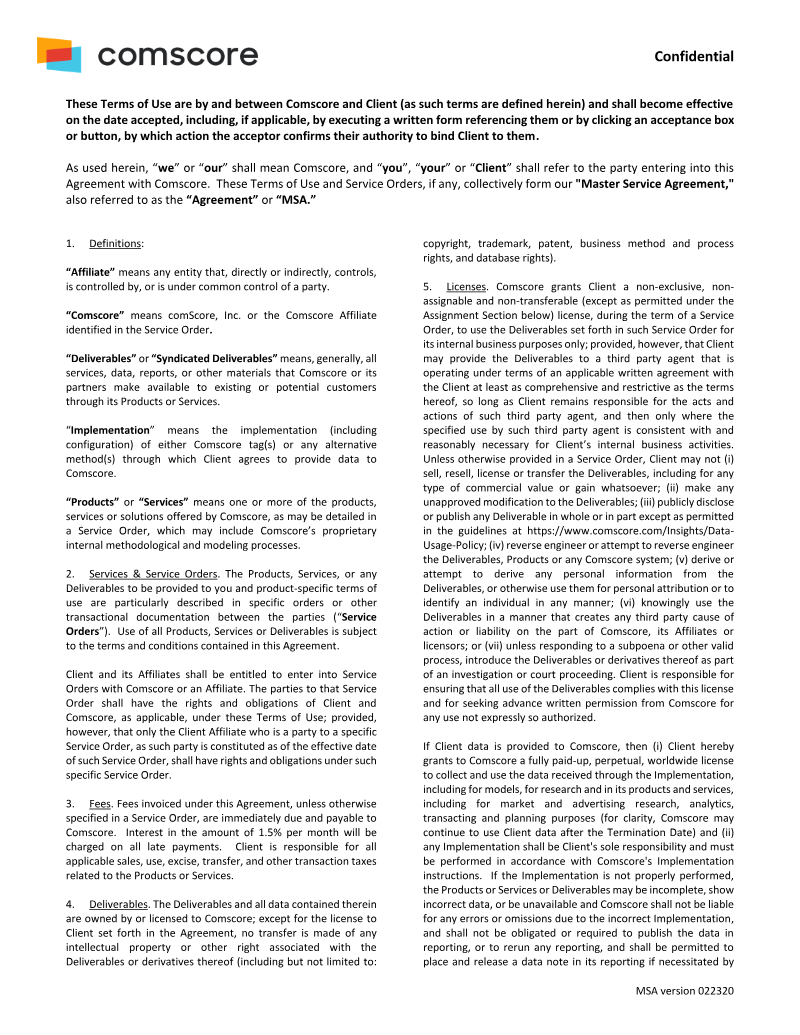
Master Service Agreement
The Master Service Agreement establishes the legal framework governing the relationship between Comscore and its clients regarding the provision of data, reports, and analytical services. The primary purpose of the agreement is to define the terms of service, licensing restrictions, intellectual property ownership, and liability limitations for the use of Comscore’s proprietary products. It serves as a foundational contract that remains in effect for an initial five-year term, with automatic one-year renewals unless terminated by either party with 90 days' notice.
Key provisions include a non-exclusive, non-transferable license for clients to use deliverables for internal business purposes only, strictly prohibiting the resale, reverse engineering, or unauthorized publication of Comscore’s data. Clients are responsible for the proper implementation of tracking tags, and Comscore retains ownership of all intellectual property, including data models and methodologies. Financial terms mandate that fees are due upon invoicing, with late payments subject to a 1.5% monthly interest charge. The agreement also outlines rigorous confidentiality requirements, data protection compliance, and specific indemnification protocols for third-party intellectual property claims.
The scope of the agreement is global, covering various international jurisdictions with specific legal venues and arbitration requirements for regions including Latin America, Europe, and Asia. In the event of disputes, the agreement mandates specific governing laws and arbitration bodies based on the client's location. Furthermore, the contract includes standard clauses regarding force majeure, export control compliance, and the status of the parties as independent contractors. It explicitly states that no unilateral terms issued by a client, such as purchase orders, can supersede the conditions set forth in this agreement.
- The Master Service Agreement between Comscore and its clients is a five-year contract that automatically renews annually unless terminated with at least 90 days' notice.
- Clients are granted a non-exclusive, non-transferable license restricted to internal business use, which strictly prohibits the resale, reverse engineering, or unauthorized publication of Comscore’s data.
- Comscore retains full ownership of all intellectual property, including proprietary data models and methodologies, while clients bear responsibility for the correct implementation of tracking tags.
- Invoices must be paid upon receipt, and overdue balances are subject to a 1.5% monthly interest charge.
- The agreement explicitly overrides any conflicting terms found in client-issued purchase orders or other unilateral documentation.
Comscore

Article
Presentations and Whitepapers
The provided collection of presentations and whitepapers serves as a central repository for industry insights, strategic guides, and market intelligence produced by Comscore. The primary purpose of these materials is to provide stakeholders across various sectors—including gaming, retail, finance, and media—with data-driven analysis to optimize marketing effectiveness, audience targeting, and cross-platform advertising strategies. The content emphasizes the evolving role of artificial intelligence in consumer behavior and the increasing complexity of programmatic advertising environments.
Key findings and thematic focuses throughout the 2025 and 2026 publications highlight a shift toward predictive analytics and contextual targeting. Specific areas of analysis include seasonal consumer trends, such as holiday shopping and flu season preparation, as well as specialized playbooks for sports, political campaigning, and streaming media. The materials underscore a broader industry transition where brands must adapt to AI-driven consumer interactions, noting that consumers are increasingly outsourcing portions of their purchase journeys to AI assistants.
The scope of these insights is global, covering a wide array of industry segments including automotive, consumer packaged goods, financial services, and gaming. The methodology relies on Comscore’s proprietary measurement tools, which evaluate advertising performance, digital audience behavior, and box office metrics across multiple screens and platforms. By aggregating these findings, the repository offers a comprehensive view of the digital landscape, providing actionable intelligence for businesses aiming to navigate shifting media consumption habits and programmatic advertising trends through the 2026 calendar year.
- Comscore’s 2026 State of Programmatic report highlights evolving trends in programmatic advertising, specifically focusing on how budgets and strategies are shifting across the industry.
- Consumer purchase journeys are increasingly being outsourced to AI assistants, a shift that is fundamentally rewriting the rules of consumer interaction for brands.
- Proximic by Comscore is actively deploying AI-driven contextual and predictive modeling to assist brands in targeting audiences for seasonal events, including the 2026 flu season and holiday shopping periods.
- The company provides specialized audience targeting playbooks and guides for major seasonal and high-engagement events, such as the 2026 football kickoff, championship games, and back-to-school periods.
- Comscore maintains a broad measurement portfolio covering cross-platform advertising, CTV, digital audiences, global box office performance, and social media value.
+1
Comscore

Report26 pages
Level Up – Harnessing the Power of Gaming Audiences
The 2024 Level Up report, a collaborative analysis by Comscore and Anzu, examines the evolving landscape of the U.S. gaming market and the expanding opportunities for brand integration. The study defines gamers as adults aged 18 to 65 who play multiple times a week, revealing that 62% of the U.S. adult population fits this criteria. A significant finding is the high level of cross-platform engagement; 77% of gamers utilize more than one device, while 40% play across all platforms, including PC, console, and mobile.
The data highlights distinct consumer behaviors based on platform preference. Console gamers demonstrate the highest willingness to pay for content, with 37% prepared to spend over $60 on a single title. In contrast, 32% of mobile-only gamers prefer free-to-play models. Genre preferences also vary by hardware, with PC players favoring first-person shooters and RPGs, while console players show a strong affinity for action-adventure and sports titles.
From an advertising perspective, the report concludes that gaming is no longer a niche silo but a mainstream medium with high receptivity to marketing. Approximately two-thirds of gamers view in-game advertisements as having a positive or neutral impact on their experience. Specifically, 34% of respondents believe product placement enhances realism, and 45% express a preference for rewarded ad formats. Case studies, such as Tommy Hilfiger’s campaign, demonstrate the efficacy of these strategies, showing a 20-point lift in brand favorability and a 23-point increase in purchase intent. The report emphasizes that the partnership between Comscore and Anzu now allows for more precise measurement of the incremental reach provided by intrinsic in-game advertising.
- Gaming is a mainstream U.S. medium, with 62% of adults aged 18–65 playing games multiple times per week.
- Cross-platform engagement is high, as 77% of gamers use more than one device and 40% play across PC, console, and mobile platforms.
- Two-thirds of gamers view in-game advertisements as having a neutral or positive impact on their experience, with 34% noting that product placement enhances realism.
- Rewarded ad formats are preferred by 45% of gamers, and campaigns like Tommy Hilfiger’s have demonstrated significant performance gains, including a 20-point lift in brand favorability and a 23-point increase in purchase intent.
- Monetization preferences are platform-dependent: 37% of console gamers are willing to spend over $60 on a single title, whereas 32% of mobile-only gamers prefer free-to-play models.
+1
ComscoreMar 2024

Report26 pages
US Gaming Audience in 2023
The gaming landscape in 2024 has solidified as a mainstream entertainment pillar, with 62% of U.S. adults aged 18 to 65 identifying as active gamers. This audience is characterized by high engagement across multiple devices, as 77% of players utilize more than one platform and 40% play across PC, console, and mobile combined. While mobile-only gamers typically prefer free-to-play titles, console and PC players demonstrate a high willingness to invest in premium content, with 45% of all gamers spending over $40 on their most recent purchase.
The demographic profile of the U.S. gaming audience skews toward Millennials and spans a wide range of household income levels. Genre preferences vary by platform; PC gamers favor first-person shooters, action, and role-playing games, while console players show a strong preference for action-adventure, sports, and racing titles. This broad reach is further amplified by the success of video game intellectual property in other media, evidenced by significant box office performance for game-inspired films.
Advertising within the gaming ecosystem presents significant opportunities for brand growth through formats such as intrinsic in-game ads, rewarded video, and sponsorships. Approximately two-thirds of gamers view advertisements as having a positive or neutral impact on their experience, with 34% noting that product placements can enhance realism. Case studies, such as campaigns by Tommy Hilfiger, demonstrate that non-intrusive in-game ads can drive substantial lifts in brand favorability, recommendation, and purchase intent. Through partnerships between measurement firms like Comscore and ad-tech providers like Anzu, advertisers can now better quantify the incremental reach provided by these specialized digital environments.
- 62% of U.S. adults aged 18 to 65 are active gamers, with 77% of players utilizing multiple platforms and 40% playing across PC, console, and mobile combined.
- 45% of all gamers spent over $40 on their most recent purchase, indicating a strong willingness to invest in premium content among PC and console users.
- Approximately two-thirds of gamers view advertisements as having a positive or neutral impact on their gaming experience, with 34% stating that product placements can enhance realism.
- Non-intrusive in-game advertising, such as campaigns by Tommy Hilfiger, has been shown to drive measurable lifts in brand favorability, recommendation, and purchase intent.
- Genre preferences are platform-specific, with PC gamers favoring first-person shooters, action, and RPGs, while console players prefer action-adventure, sports, and racing titles.
ComscoreMar 2024