11 bit studios
Game Co.217 documents
Documents
Legal12 pages
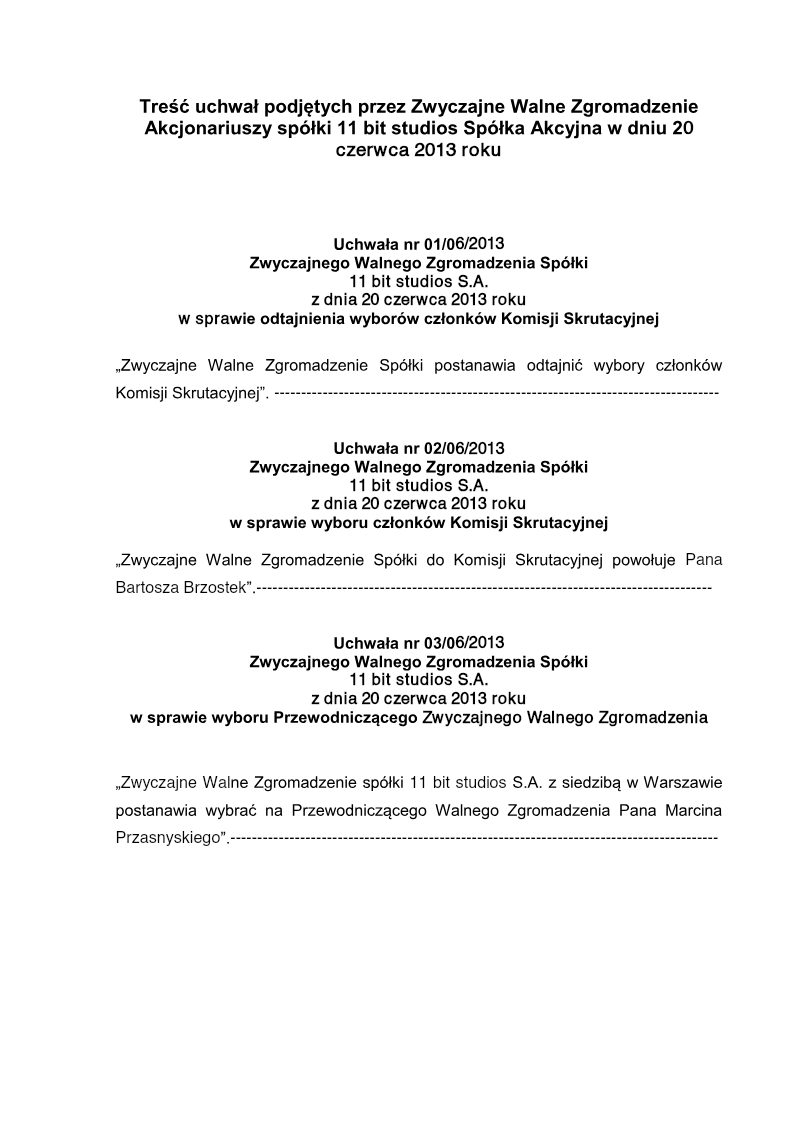
Resolutions Adopted by the Ordinary General Meeting — 11 bit studios S.A. (June 2013)
The Ordinary General Meeting of Shareholders for 11 bit studios S.A., held on June 20, 2013, in Warsaw, resulted in the adoption of twenty-three resolutions governing the company’s financial oversight and corporate governance. The primary purpose of the meeting was to approve the financial results for the 2012 fiscal year, discharge company leadership from their duties, and restructure the Supervisory Board.
Financial disclosures for the period ending December 31, 2012, reveal that the company achieved a net profit of 1,344,700.33 PLN, with total assets valued at 7,336,527.82 PLN. Shareholders voted to allocate the entirety of the 2012 net profit to the company’s reserve capital. Following the review of the Management Board's activity report and the auditor's opinion, the assembly granted discharge to all members of the Management Board, including President Grzegorz Miechowski, and the sitting members of the Supervisory Board for their performance during the 2012 financial year.
The meeting also established a new composition for the Supervisory Board, fixing the number of members at five. Through secret ballots, Martin John Balawajder, Piotr Sulima, Szymon Kowalczyk, Radosław Marter, and Agnieszka Maria Kruz were appointed to the board, with Martin John Balawajder selected as Chairman. Furthermore, the assembly set the annual remuneration for the Chairman at 3,000 PLN and for other board members at 1,500 PLN, payable within 30 days of the close of the fiscal year. These resolutions were enacted in accordance with the Polish Commercial Companies Code and the company’s internal statutes.
- 11 bit studios S.A. reported a net profit of 1,344,700.33 PLN for the 2012 fiscal year, with total assets valued at 7,336,527.82 PLN as of December 31, 2012.
- Shareholders voted to allocate the entire 2012 net profit of 1,344,700.33 PLN to the company’s reserve capital rather than distributing it as dividends.
- The Ordinary General Meeting formally granted discharge to the Management Board, including President Grzegorz Miechowski, and the Supervisory Board for their performance during the 2012 financial year.
- The Supervisory Board was restructured to a five-member body consisting of Martin John Balawajder (Chairman), Piotr Sulima, Szymon Kowalczyk, Radosław Marter, and Agnieszka Maria Kruz.
- Annual remuneration for the new Supervisory Board was set at 3,000 PLN for the Chairman and 1,500 PLN for each of the four other members, payable within 30 days of the fiscal year-end.
+1
11 bit studiosJun 2013
Legal1 pages
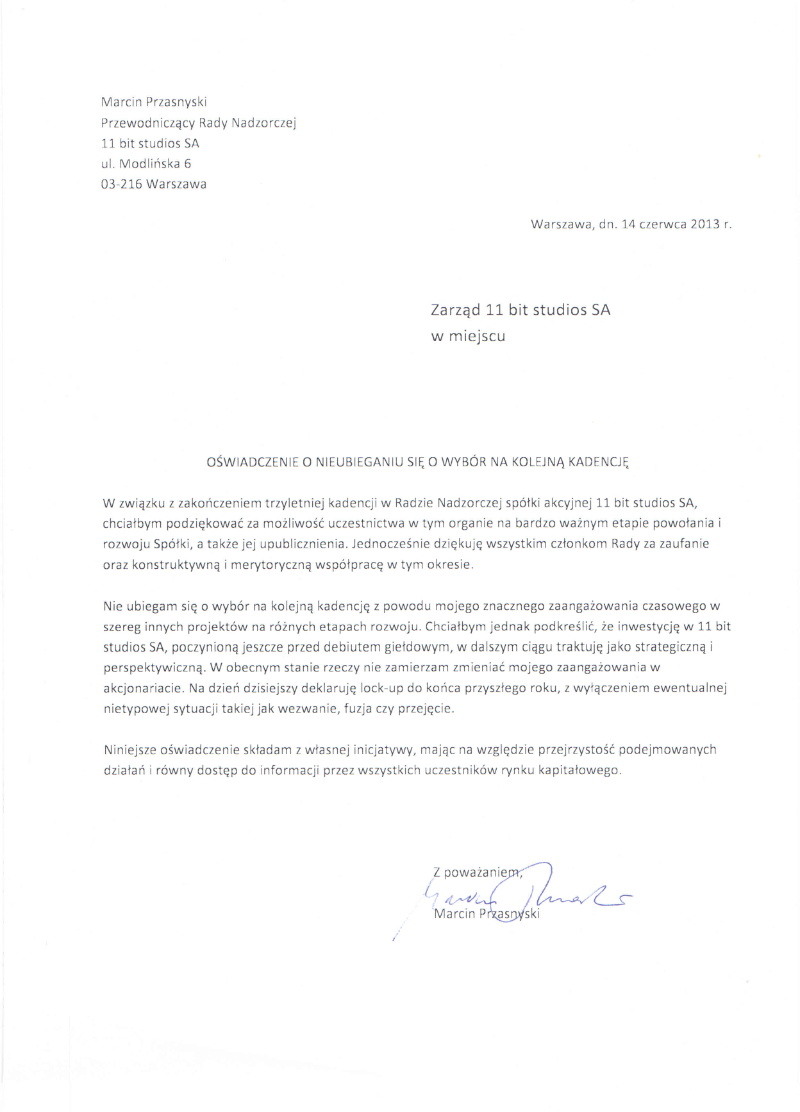
Statement of Not Seeking Re-election for Next Term
Marcin Przasnyski, the Chairman of the Supervisory Board at 11 bit studios SA, formally announced his decision not to seek re-election for a subsequent term following the conclusion of his three-year tenure. This declaration, issued in Warsaw on June 14, 2013, marks the end of his direct oversight during a critical phase of the company’s history, which included its founding, initial development, and transition to a publicly traded entity. The primary reason cited for this departure is a significant time commitment to various other projects at different stages of development, which prevents continued service on the board.
Despite stepping down from his leadership role, the outgoing chairman maintains a positive outlook on the company’s financial and operational trajectory. He characterizes his investment in the studio, which originated prior to its stock market debut, as both strategic and long-term. Consequently, he intends to maintain his current shareholding position without immediate divestment. To reinforce this commitment to market stability and transparency, he voluntarily declared a lock-up period on his shares lasting until the end of 2014, with exceptions only for extraordinary corporate events such as a merger, acquisition, or tender offer.
This communication serves as a formal disclosure to the management board and the broader capital market, ensuring that all stakeholders have equal access to information regarding changes in corporate governance. By proactively addressing his departure and future intentions as a shareholder, the outgoing chairman aims to provide clarity and maintain investor confidence during the transition period. The scope of this action is limited to the internal governance and shareholding structure of the Polish game development sector as represented by 11 bit studios SA during the mid-2013 period.
- Marcin Przasnyski, Chairman of the Supervisory Board at 11 bit studios SA, announced on June 14, 2013, that he will not seek re-election after his three-year term concludes.
- Przasnyski is stepping down to focus on other professional projects that require significant time commitments.
- Despite leaving his leadership role, Przasnyski intends to retain his current shareholding in the company, citing a long-term strategic investment outlook.
- To maintain investor confidence, Przasnyski has voluntarily committed to a lock-up period on his shares lasting until the end of 2014.
- The lock-up agreement includes specific exceptions for extraordinary corporate events, such as mergers, acquisitions, or tender offers.
+1
11 bit studiosJun 2013
Legal9 pages
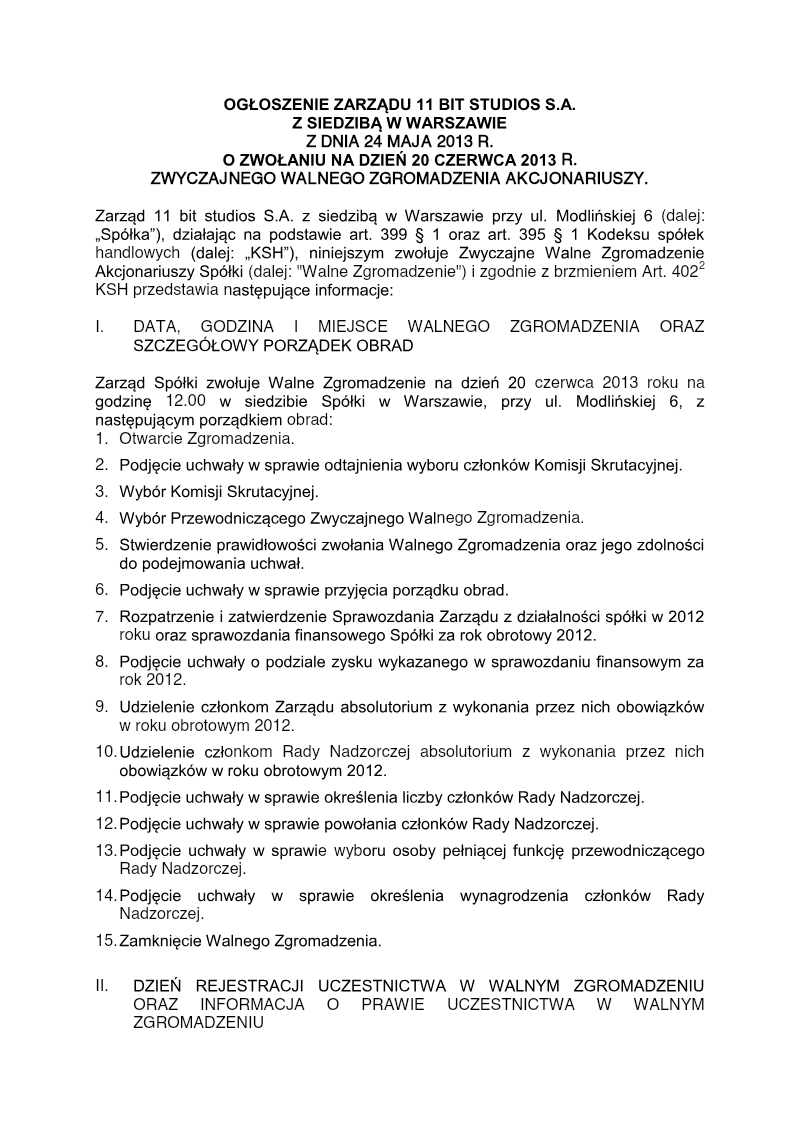
Board Announcement — 11 bit studios S.A. Convening Ordinary General Meeting (2013)
The Management Board of 11 bit studios S.A., headquartered in Warsaw, issued a formal notice on May 24, 2013, convening an Ordinary General Meeting of Shareholders scheduled for June 20, 2013. The primary purpose of the meeting is to conduct standard year-end corporate governance activities for the 2012 fiscal year. The agenda includes the review and approval of the Management Board's activity report and the financial statements for 2012, the adoption of a resolution regarding the distribution of profits, and the granting of discharge to members of both the Management Board and the Supervisory Board for their performance during the period.
Beyond financial approvals, the meeting is tasked with several structural governance decisions. These include determining the number of members for the Supervisory Board, appointing those members, selecting a Chairperson for the Board, and establishing their remuneration. The document outlines a total of 2,217,199 outstanding shares across Series A through E, each carrying one vote, representing the total voting power available at the assembly.
The scope of the announcement is strictly focused on the Polish legal framework, specifically citing the Commercial Companies Code. Participation is restricted to shareholders of record as of June 4, 2013. The document details rigorous administrative procedures for shareholder participation, including the requirements for powers of attorney, the submission of draft resolutions by those holding at least five percent of share capital, and the verification of identity through official registries or identity documents. Notably, the company’s articles of association at this time did not permit electronic participation or voting; all voting and speech were required to take place in person at the Warsaw headquarters, though communication regarding proxies and documentation could be handled via PDF and email.
- 11 bit studios S.A. convened an Ordinary General Meeting for June 20, 2013, to conduct fiscal year 2012 corporate governance and financial approvals.
- The meeting agenda included the approval of 2012 financial statements, profit distribution, and the granting of discharge to the Management and Supervisory Boards.
- The company had 2,217,199 outstanding shares across Series A through E, with each share carrying one vote.
- Governance tasks included setting the size of the Supervisory Board, appointing its members, selecting a Chairperson, and establishing remuneration.
- Shareholder participation was restricted to those of record as of June 4, 2013, and required in-person attendance at the Warsaw headquarters.
+1
11 bit studiosMay 2013
Financial71 pages
Annual Report of 11 bit studios S.A. for 2012
The 2012 fiscal year marked a period of significant financial expansion and strategic consolidation for 11 bit studios S.A., characterized by a 57% increase in net revenue to 4.8 million PLN and a net profit of 1.34 million PLN. This performance represents a robust recovery from the previous year's losses, driven by the release of eleven products, including Funky Smugglers, Sleepwalker’s Journey, and various ports of the Anomaly franchise. While revenues exceeded initial forecasts by 10%, net profit reached only 77% of projections due to the strategic decision to postpone the major release of Anomaly 2 into 2013.
The company’s financial structure strengthened considerably over the period, with total assets growing from 2.99 million PLN to 7.34 million PLN. This growth was supported by successful Series D and E share issuances, notably involving a strategic investment from the AMPLICO pension fund, which helped raise over 3 million PLN in net financing. By the end of 2012, the company maintained a high equity-to-asset ratio of 94.2% and a strong cash position of 3.47 million PLN. Management prioritized organic growth over dividend payouts, noting that the internal value of the firm had increased 5.5-fold since its 2010 market debut.
Operations were heavily export-oriented, with approximately 95% of sales revenue generated from foreign markets in USD, EUR, and GBP. This international focus necessitates active management of currency fluctuation risks and platform-specific challenges. To mitigate risks associated with closed ecosystems like Sony and Microsoft, the company emphasized cross-platform development for open systems such as PC and mobile. Despite facing a competitive labor market for experienced developers in Poland, the company intensified its game development activity, nearly doubling its work-in-progress inventories to 1.72 million PLN as it prepared for its 2013 release pipeline.
- 11 bit studios achieved a 57% increase in net revenue to 4.8 million PLN and a net profit of 1.34 million PLN in 2012, marking a recovery from the previous year's losses.
- The company strengthened its financial position by raising over 3 million PLN through Series D and E share issuances, including a strategic investment from the AMPLICO pension fund.
- Total assets grew from 2.99 million PLN to 7.34 million PLN, resulting in a strong end-of-year cash position of 3.47 million PLN and an equity-to-asset ratio of 94.2%.
- Revenue exceeded initial forecasts by 10%, though net profit reached only 77% of projections due to the strategic decision to delay the release of Anomaly 2 until 2013.
- Approximately 95% of sales revenue was generated from foreign markets, necessitating active management of currency risks associated with USD, EUR, and GBP.
+1
11 bit studiosApr 2013
Legal18 pages
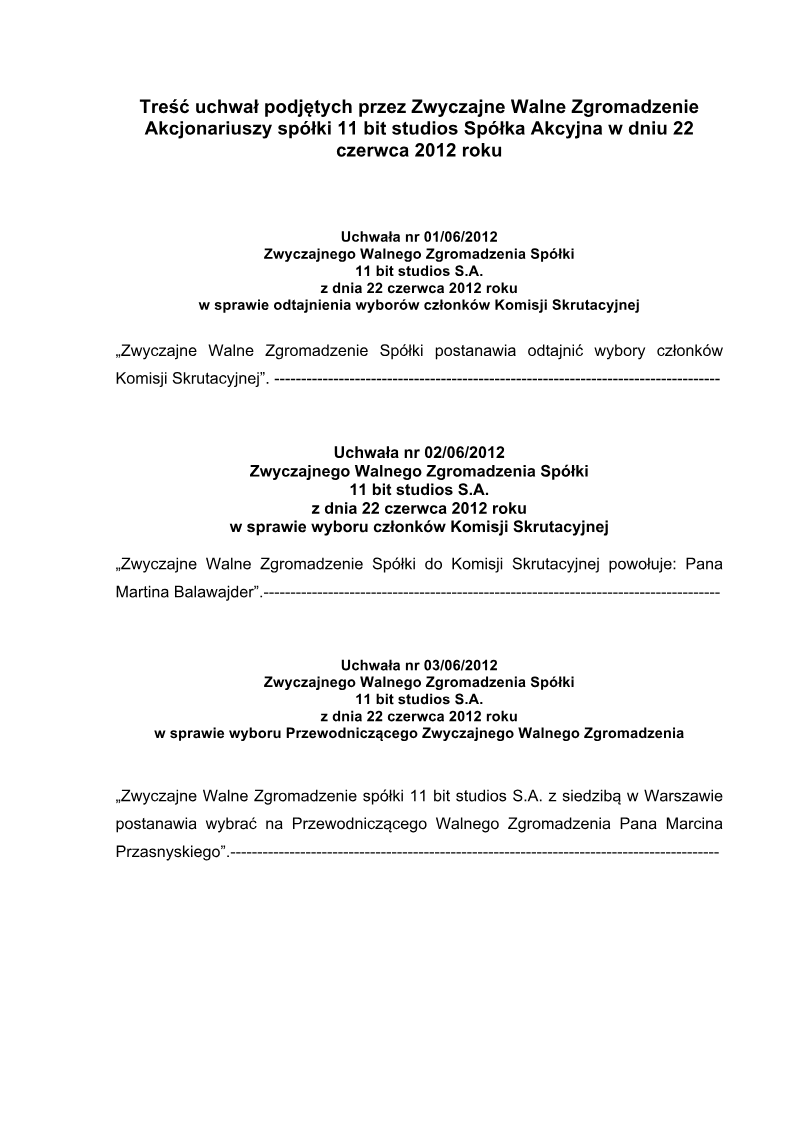
Resolutions Adopted by the Ordinary General Meeting of Shareholders of 11 bit studios S.A. on June 22, 2012
The Ordinary General Meeting of 11 bit studios S.A., held on June 22, 2012, established a strategic framework for the company’s financial recovery and future expansion following the 2011 fiscal year. During this period, the company reported a net profit of 1,292,777.32 PLN, which shareholders elected to retain for the purpose of offsetting historical losses and bolstering supplementary capital. To further fuel development, the company authorized a significant capital increase through the issuance of up to 400,000 Series E shares via private subscription. These shares, priced at a minimum of 9.00 PLN each, were designated for dematerialization and subsequent listing on the Warsaw Stock Exchange’s NewConnect alternative trading system.
Beyond immediate financial restructuring, the company formalized a broad operational scope and a rigid corporate governance hierarchy. The updated Articles of Association expanded the business profile to encompass software development, game publishing, and the production of electronic equipment. Governance is structured around a Management Board and a Supervisory Board consisting of three to five members, with specific qualified majorities required for fundamental changes to the company’s business profile or share redemption.
The long-term fiscal stability of the firm is supported by a mandate to allocate at least 8% of annual net profits to supplementary capital until that reserve reaches one-third of the total share capital. By the conclusion of these proceedings, the total share capital was set to reach a maximum of 231,169.90 PLN, divided across five share series. These measures collectively transition the company from a recovery phase into a structured growth phase, supported by both public market integration and internal capital preservation policies.
- 11 bit studios S.A. authorized a capital increase of up to 400,000 Series E shares, priced at a minimum of 9.00 PLN each, for listing on the Warsaw Stock Exchange’s NewConnect market.
- Shareholders elected to retain the 2011 net profit of 1,292,777.32 PLN to offset historical losses and strengthen the company's supplementary capital.
- The company mandated that at least 8% of annual net profits must be allocated to supplementary capital until that reserve reaches one-third of the total share capital.
- Following the June 22, 2012 meeting, the company's total share capital was set to reach a maximum of 231,169.90 PLN across five share series.
- The Articles of Association were updated to formally expand the company's business scope to include software development, game publishing, and electronic equipment production.
11 bit studiosJun 2012
Financial68 pages
Annual Report of 11 bit studios S.A. for 2011
During the 2011 fiscal year, 11 bit studios S.A. successfully transitioned from a development-focused startup into a profitable global commercial entity. This transformation was primarily driven by the critical and commercial success of the Anomaly Warzone Earth series, which enabled the company to report a net profit of 1.29 million PLN. This represents a significant turnaround from the net loss of 231,199 PLN recorded in 2010. Net sales revenue surged by over 544% to 3.05 million PLN, characterized by a high-margin strategy where nearly 50% of sales were converted to profit.
The company’s operations are heavily international, with 96% of product sales originating from foreign markets through digital distribution platforms such as Steam and the App Store. Consequently, the firm maintains a high exposure to currency fluctuations, as 80-100% of its revenue is denominated in USD, EUR, and GBP. To support its growth trajectory, the company utilized a Series D share issuance to raise capital, ending the year with a strengthened cash position of 1.30 million PLN and total assets exceeding 2.99 million PLN. These resources are being deployed to fund the simultaneous development of four new game series.
Operational risks remain centered on the inherent unpredictability of consumer demand and a strategic dependency on major platform owners like Sony and Microsoft. To mitigate these factors, the company prioritizes diversification across open platforms and utilizes rigorous usability testing. Audited financial statements confirm that the firm is in a stable position with no threats to continued operations. Looking forward, the company has set ambitious growth targets, aiming for 12.7 million PLN in revenue by 2013 while maintaining its commitment to transparency standards as a listed entity on the NewConnect market.
- 11 bit studios achieved a significant financial turnaround in 2011, reporting a net profit of 1.29 million PLN compared to a 231,199 PLN loss in 2010.
- Net sales revenue grew by over 544% to 3.05 million PLN, driven primarily by the commercial success of the Anomaly Warzone Earth series.
- The company operates as a global entity with 96% of sales originating from foreign markets via digital platforms like Steam and the App Store.
- Revenue is highly sensitive to currency fluctuations, as 80-100% of income is denominated in USD, EUR, and GBP.
- Following a Series D share issuance, the company ended 2011 with 1.30 million PLN in cash and total assets exceeding 2.99 million PLN.
+1
11 bit studiosJun 2012
Legal10 pages
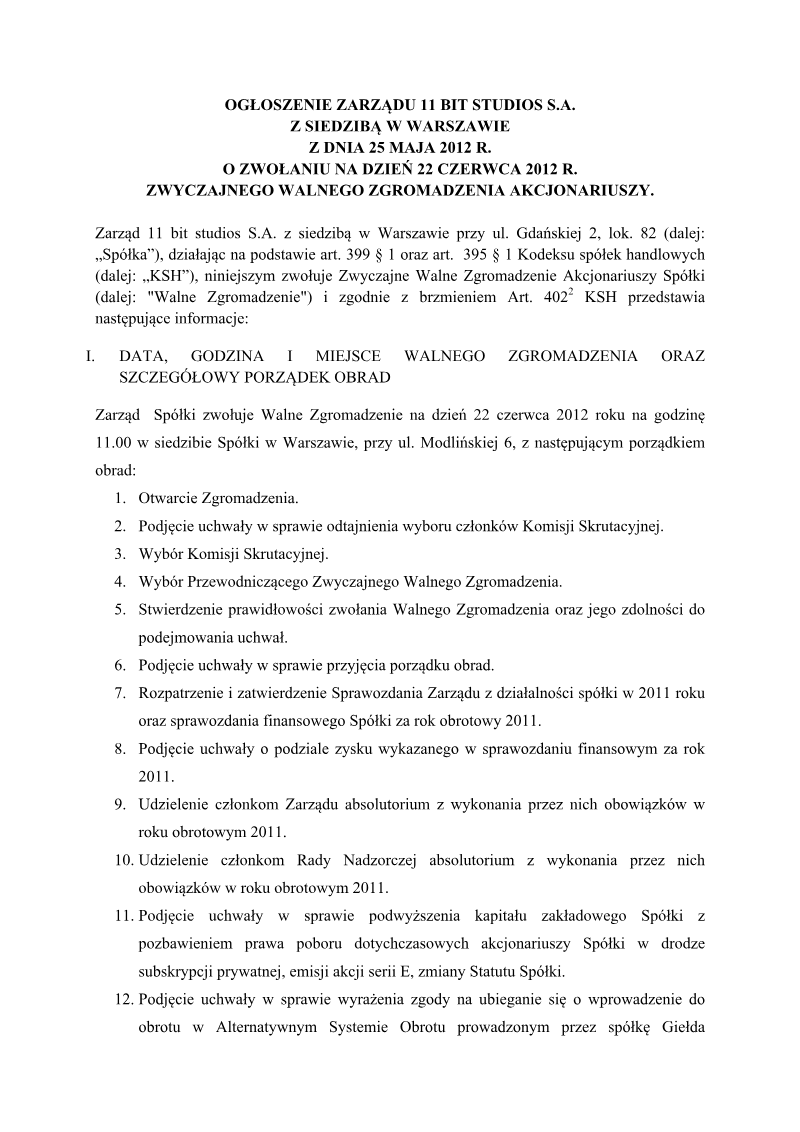
Announcement of the Management Board 11 Bit Studios S.A.
The Management Board of 11 bit studios S.A., headquartered in Warsaw, issued a formal notice on May 25, 2012, convening an Ordinary General Meeting of Shareholders scheduled for June 22, 2012. The primary purpose of the meeting is to conduct standard annual corporate governance tasks and address specific capital restructuring initiatives. As of the announcement date, the company’s share capital consisted of 1,911,699 shares, each corresponding to one vote.
The agenda includes the review and approval of the Management Board's report on 2011 activities and the financial statements for the 2011 fiscal year. Shareholders will vote on the distribution of 2011 profits and grant discharge to members of both the Management Board and the Supervisory Board for their performance. Critically, the meeting will address a resolution to increase the company's share capital through the private subscription of Series E shares, involving the exclusion of existing shareholders' pre-emptive rights. Furthermore, the board seeks approval to apply for the introduction of these Series E shares into the Alternative Trading System managed by the Warsaw Stock Exchange and to proceed with their dematerialization.
The document outlines strict procedural requirements for participation, noting that the registration date for the meeting is June 6, 2012. Shareholders representing at least one-twentieth of the share capital maintain the right to request additions to the agenda or submit draft resolutions. While the company allows for the electronic notification of proxies and the submission of documents in PDF format, the company’s statutes do not currently permit participation, speech, or voting via electronic communication means during the meeting itself. All proceedings are governed by the Polish Commercial Companies Code.
- 11 bit studios S.A. is seeking to increase its share capital through a private subscription of Series E shares, which includes the exclusion of existing shareholders' pre-emptive rights.
- The company intends to apply for the introduction of the new Series E shares into the Alternative Trading System on the Warsaw Stock Exchange and proceed with their dematerialization.
- The Ordinary General Meeting of Shareholders is scheduled for June 22, 2012, to review 2011 financial performance and approve the distribution of 2011 profits.
- As of May 25, 2012, the company’s total share capital consists of 1,911,699 shares, with each share carrying one vote.
- The meeting agenda includes granting formal discharge to members of both the Management Board and the Supervisory Board for their performance during the 2011 fiscal year.
+2
11 bit studiosMay 2012
Legal18 pages
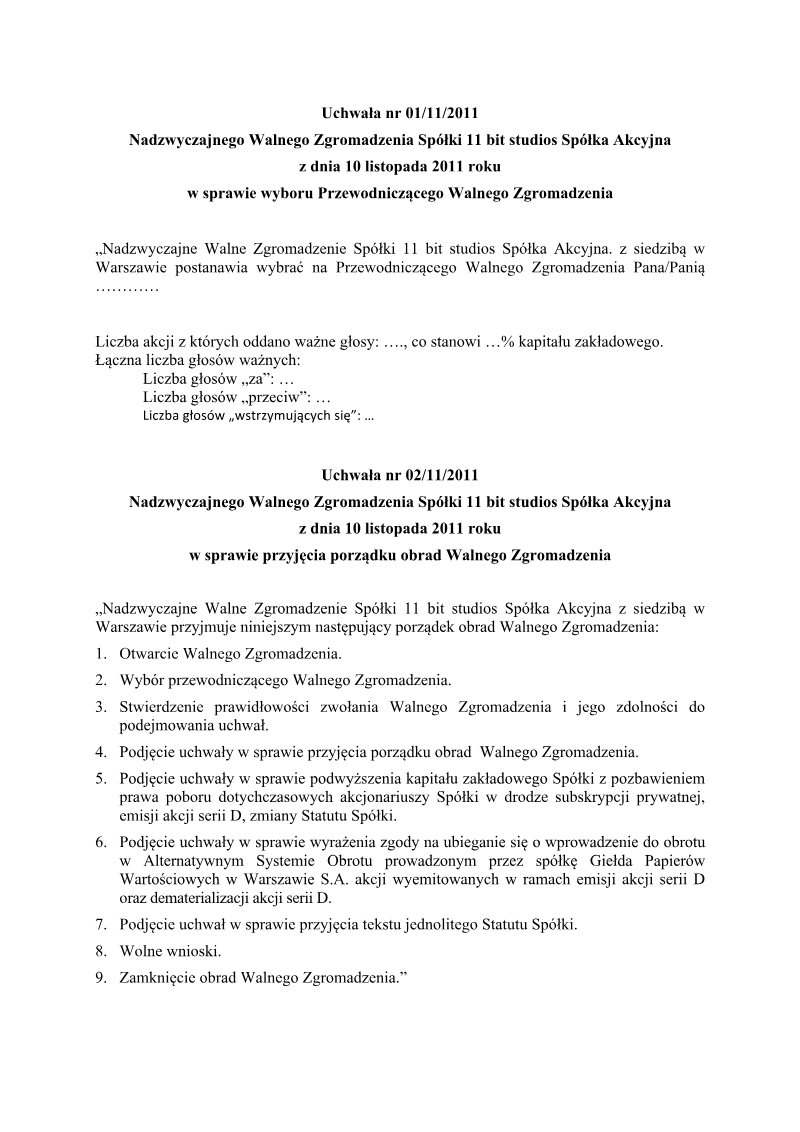
Resolution No. 01/11/2011 of the Extraordinary General Meeting of 11 bit studios
The proposed expansion of 11 bit studios in late 2011 centers on a strategic increase in share capital to accelerate internal development and market competitiveness. By issuing up to 500,000 Series D ordinary bearer shares, the company aims to raise its share capital from 187,076.10 PLN to a maximum of 237,076.10 PLN. This capital hike is structured as a private subscription that intentionally waives the pre-emptive rights of existing shareholders. This approach is designed to attract institutional investors who can provide not only the necessary financial liquidity but also specialized industry expertise to support the company’s long-term growth objectives.
The primary objective of this fundraising effort is the establishment of a third internal development team. The resulting capital will cover the initial production costs of new software projects and fund aggressive marketing campaigns intended to solidify the company’s standing within the global gaming market. To facilitate this growth, the management is authorized to pursue the dematerialization of these new shares and seek their admission to the New Connect Alternative Trading System on the Warsaw Stock Exchange. This move aligns with the company’s broader operational framework, which encompasses game publishing, software development, and film production.
Structurally, the company maintains a governance model consisting of a General Meeting, a Supervisory Board, and a Management Board, each operating on three-year terms. Financial stability is reinforced by a mandate to allocate at least 8% of annual profits to supplementary capital until it reaches one-third of the total share capital. By integrating these financial and operational strategies, the company seeks to transition into a more robust phase of production, leveraging external investment to scale its creative output and distribution capabilities within the digital entertainment industry.
- 11 bit studios initiated a capital increase in late 2011 by issuing up to 500,000 Series D ordinary bearer shares to raise share capital from 187,076.10 PLN to a maximum of 237,076.10 PLN.
- The company waived existing shareholders' pre-emptive rights to facilitate a private subscription aimed at attracting institutional investors for both capital and industry expertise.
- The primary operational goal of the fundraising is to establish a third internal development team and fund the production and marketing of new software projects.
- Management is authorized to pursue the dematerialization of the new shares and seek their admission to the New Connect Alternative Trading System on the Warsaw Stock Exchange.
- The company mandates that at least 8% of annual profits must be allocated to supplementary capital until it reaches one-third of the total share capital to ensure financial stability.
+1
11 bit studiosNov 2011
Legal16 pages
Resolutions Adopted by the Extraordinary General Meeting — 11 bit studios S.A. (November 2011)
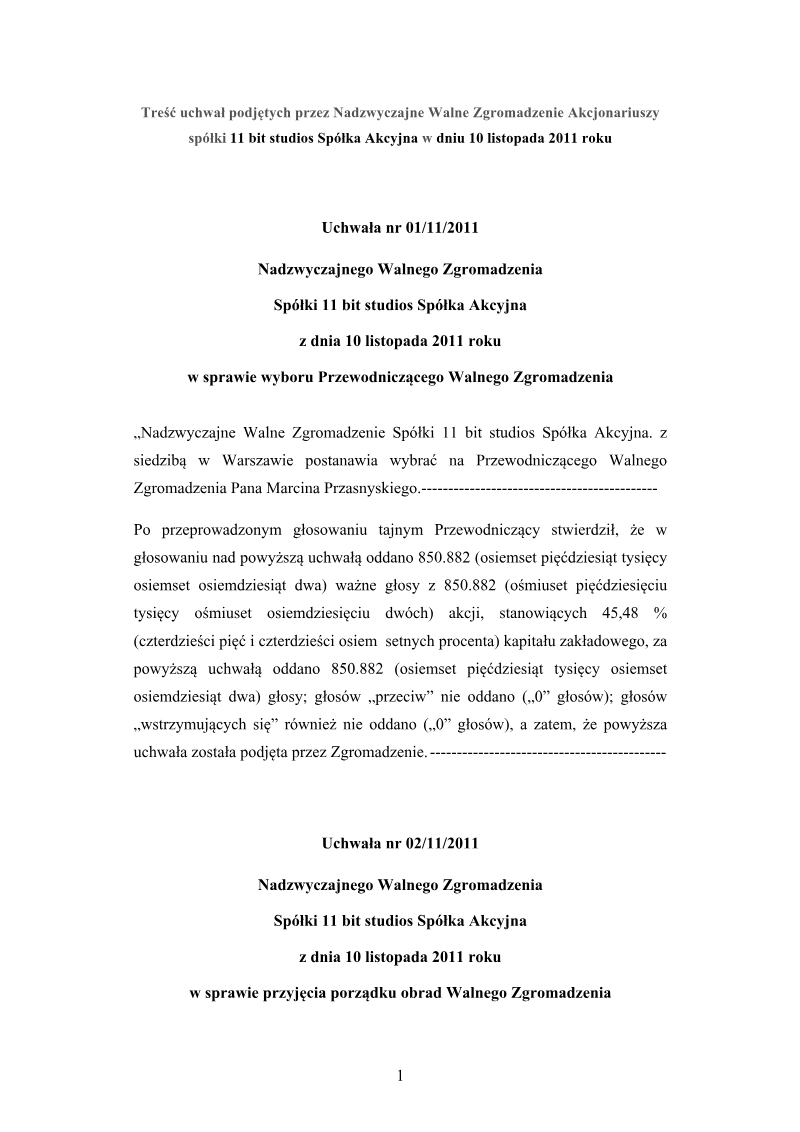
On November 10, 2011, 11 bit studios S.A. enacted a strategic capital restructuring aimed at fueling business development through a private issuance of up to 500,000 Series D shares. This move increased the company's share capital from 187,076.10 PLN to a maximum of 237,076.10 PLN, with a nominal value of 0.10 PLN per share. Shareholders unanimously approved the waiver of pre-emptive rights to facilitate this expansion and authorized the dematerialization and subsequent listing of the new shares on the NewConnect Alternative Trading System.
The corporate framework supports a broad operational mandate centered on video game publishing and software development, while also encompassing hardware production and various media activities. To accommodate this growth, the company adopted a unified text for its Articles of Association, formalizing a governance structure that includes a General Meeting, a Supervisory Board, and a Management Board. This structure ensures clear oversight and operational continuity, particularly through the establishment of three-year joint terms for Management Board members.
Governance protocols require dual representation for multi-person boards, necessitating the signatures of two members or one member alongside a proxy for legal validity. These resolutions, passed with 45.48% of the share capital represented, solidify the legal and financial foundation necessary for the firm to scale its operations within the Polish technology and gaming sectors. By aligning its fiscal year with the calendar year and streamlining its internal bylaws, the organization established a transparent regulatory environment for its transition into a more robust publicly traded entity.
- 11 bit studios S.A. authorized a private issuance of up to 500,000 Series D shares on November 10, 2011, to fund business development.
- The share issuance increased the company's total share capital from 187,076.10 PLN to a maximum of 237,076.10 PLN, with a nominal value of 0.10 PLN per share.
- Shareholders unanimously approved the waiver of pre-emptive rights and authorized the dematerialization and listing of the new shares on the NewConnect Alternative Trading System.
- The company formalized a governance structure consisting of a General Meeting, a Supervisory Board, and a Management Board with three-year joint terms for board members.
- Legal validity for the company requires dual representation, necessitating the signatures of two Management Board members or one member acting with a proxy.
+1
11 bit studiosNov 2011
Legal3 pages
Conclusion of Subscription of Ordinary Shares for Series D
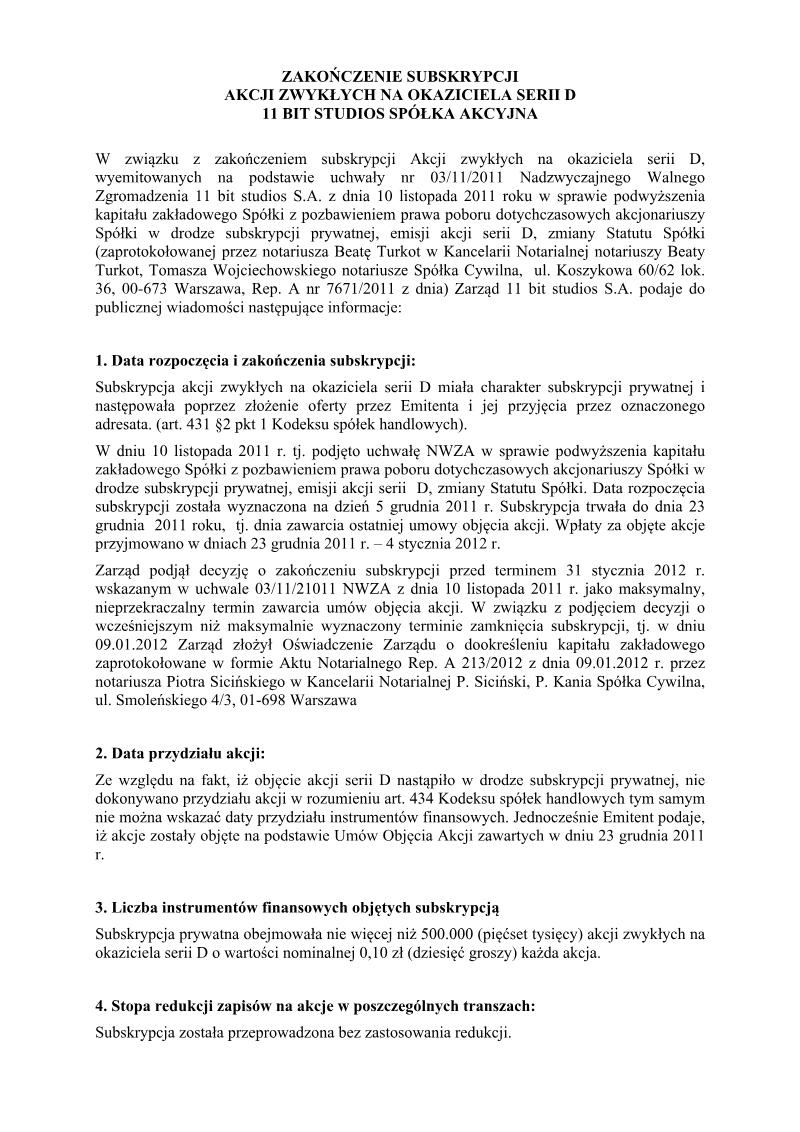
This corporate notification details the successful conclusion of a private subscription for Series D ordinary bearer shares by 11 bit studios S.A. The primary objective of the issuance was to increase the company's share capital through a private placement, which excluded pre-emptive rights for existing shareholders. The subscription period officially commenced on December 5, 2011, and concluded ahead of schedule on December 23, 2011, following the execution of the final share subscription agreements.
The offering was targeted at a specific group of 64 potential investors, with 10 investors ultimately entering into agreements to acquire the shares. While the company initially authorized the issuance of up to 500,000 shares, the final subscription resulted in the placement of 40,938 shares. Each share, carrying a nominal value of 0.10 PLN, was issued at an emission price of 9.00 PLN. Because the process was conducted as a private subscription, no formal share allotment reduction was necessary.
Financial data indicates that the total costs associated with the Series D issuance amounted to 46,722 PLN. This figure includes 41,722 PLN for offer preparation and notary fees, and 5,000 PLN for advisory services and the preparation of information documents. No costs were incurred for underwriting or promotion. Accounting for these expenses follows standard Polish accounting regulations, where costs are initially recorded as prepayments and subsequently settled against supplementary capital following the formal registration of the capital increase. This issuance reflects the company's early-stage financing activities within the Polish capital market framework.
- 11 bit studios S.A. successfully concluded a private placement of Series D ordinary shares on December 23, 2011, raising capital through the issuance of 40,938 shares.
- The shares were issued at a price of 9.00 PLN per share, significantly above the nominal value of 0.10 PLN, with the total issuance falling well below the authorized limit of 500,000 shares.
- The private subscription process involved 10 participating investors out of 64 initially targeted, with no pre-emptive rights granted to existing shareholders.
- Total costs associated with the Series D issuance amounted to 46,722 PLN, comprising 41,722 PLN for preparation and notary fees and 5,000 PLN for advisory services.
- The company incurred no costs for underwriting or promotion during this capital-raising exercise.
11 bit studiosNov 2011
Legal14 pages
Minutes of the Ordinary General Meeting — 11 bit studios S.A. (June 2011)
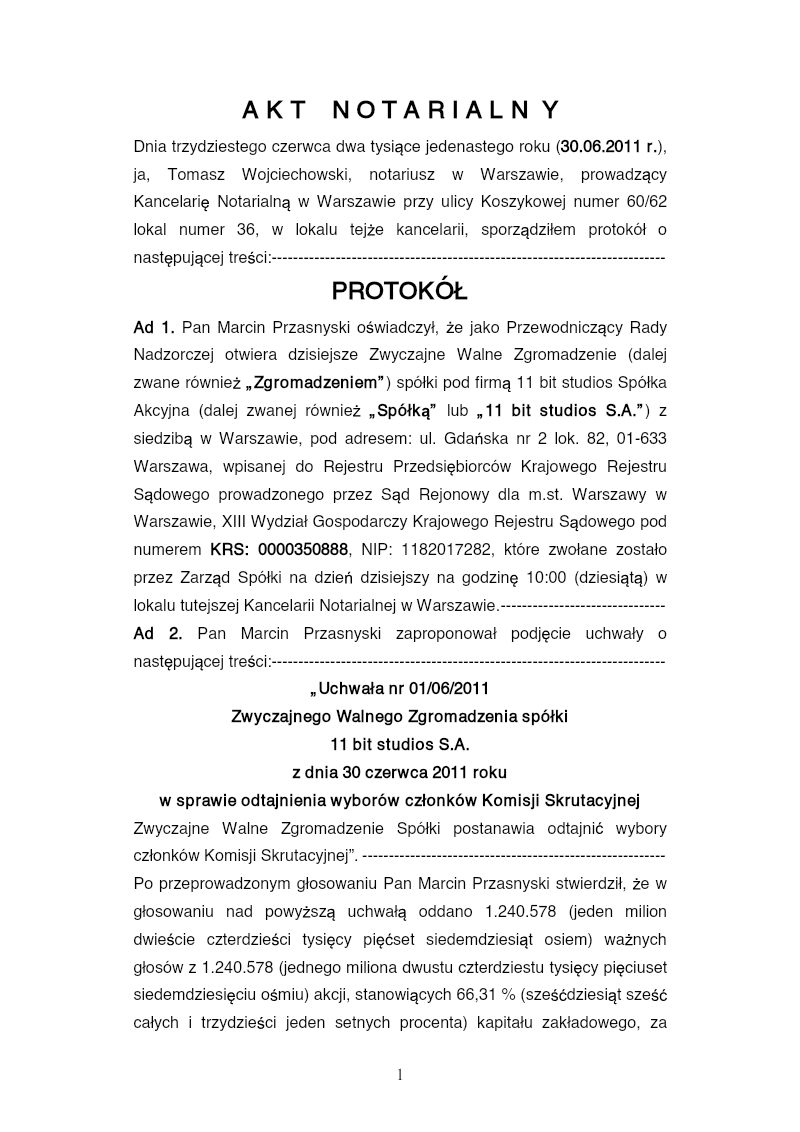
This notarial deed records the proceedings and resolutions of the Ordinary General Meeting of 11 bit studios S.A., held on June 30, 2011, in Warsaw. The primary purpose of the meeting was to conduct standard annual corporate governance tasks, including the review of the company’s initial operational period from its inception on December 7, 2009, through the end of the 2010 fiscal year. The meeting was attended by five shareholders representing 1,240,578 shares, which accounted for 66.31% of the company’s total share capital.
Key financial findings disclosed during the session indicate that the company closed the 2010 fiscal year with a net loss of 231,199.53 PLN. The total balance sheet value as of December 31, 2010, was reported at 1,352,359.17 PLN. Shareholders formally approved the Management Board's report and the financial statements, subsequently passing a resolution to cover the accumulated loss using future profits.
The assembly also focused on administrative and leadership oversight. Shareholders unanimously granted discharge (absolutorium) to all members of the Management Board—Grzegorz Miechowski, Bartosz Brzostek, Michał Drozdowski, and Przemysław Marszał—and the Supervisory Board for the performance of their duties during the 2010 period. Voting for these discharges was conducted via secret ballot, with relevant board members abstaining from votes concerning their own conduct as required by the Commercial Companies Code. The document concludes with the formal closing of the meeting after all agenda items, including the election of the Scrutiny Committee and the Chairman, were resolved without opposition.
- 11 bit studios S.A. concluded its 2010 fiscal year with a net loss of 231,199.53 PLN.
- As of December 31, 2010, the company reported a total balance sheet value of 1,352,359.17 PLN.
- Shareholders formally resolved to cover the 2010 accumulated loss using the company's future profits.
- The Ordinary General Meeting held on June 30, 2011, represented 66.31% of the company's total share capital through five attending shareholders.
- Shareholders unanimously granted discharge (absolutorium) to all members of the Management Board and Supervisory Board for their performance during the 2010 period.
+2
11 bit studiosJun 2011
Financial54 pages
Annual Report of 11 bit studios S.A. for 2010
The inaugural fiscal period for 11 bit studios S.A., spanning from December 7, 2009, to December 31, 2010, was defined by the transition from a startup venture to a publicly traded entity on Poland’s NewConnect market. The primary focus of this period was the development of the company’s debut title, Anomaly Warzone Earth, and the establishment of a multi-platform distribution strategy. While the company reported a net loss of 231,199 PLN, this result reflects a pre-revenue production phase characterized by disciplined cost management and significant investment in work-in-progress assets, which totaled over 457,000 PLN by year-end.
The financial structure was significantly bolstered through multiple share issuances, raising approximately 1.5 million PLN and increasing total equity to over 1.26 million PLN. This capital influx provided a high level of liquidity, evidenced by a current ratio of 20.6 and a year-end cash balance of 731,783 PLN. Despite negative profitability ratios typical of the early development cycle, an independent auditor issued an unqualified opinion, confirming the company’s stability and its ability to continue as a going concern. Founding shareholders retained a dominant 78.88% stake, ensuring leadership continuity during this foundational stage.
Operational risks identified during this period include the high competition for experienced development talent in Poland and the challenges of navigating restrictive licensing and approval processes from major platform holders like Sony and Microsoft. To mitigate these, management implemented proprietary recruitment and training systems. Strategically, the company committed to transparency and corporate governance standards required by the NewConnect market, successfully validating its business model ahead of its formal commercial launch. This period established the necessary financial and operational infrastructure to support a growth strategy centered on high-quality, independent intellectual property.
- 11 bit studios concluded its inaugural fiscal period (Dec 2009–Dec 2010) with a net loss of 231,199 PLN, consistent with a pre-revenue development phase focused on its debut title, Anomaly Warzone Earth.
- The company secured financial stability through share issuances that raised approximately 1.5 million PLN, resulting in a year-end cash balance of 731,783 PLN and a strong current ratio of 20.6.
- By the end of 2010, the company had invested over 457,000 PLN into work-in-progress assets, establishing the operational infrastructure required for its multi-platform distribution strategy.
- Founding shareholders maintained a 78.88% controlling stake, ensuring leadership continuity as the company transitioned into a publicly traded entity on Poland’s NewConnect market.
- Management identified high competition for development talent and restrictive licensing processes from platform holders like Sony and Microsoft as primary operational risks.
+2
11 bit studiosJun 2011