
University of Copenhagen
The University of Copenhagen is a Danish public research and education institution. It publishes academic research, including work on gaming, gambling and social media platforms such as Twitch.
Documents
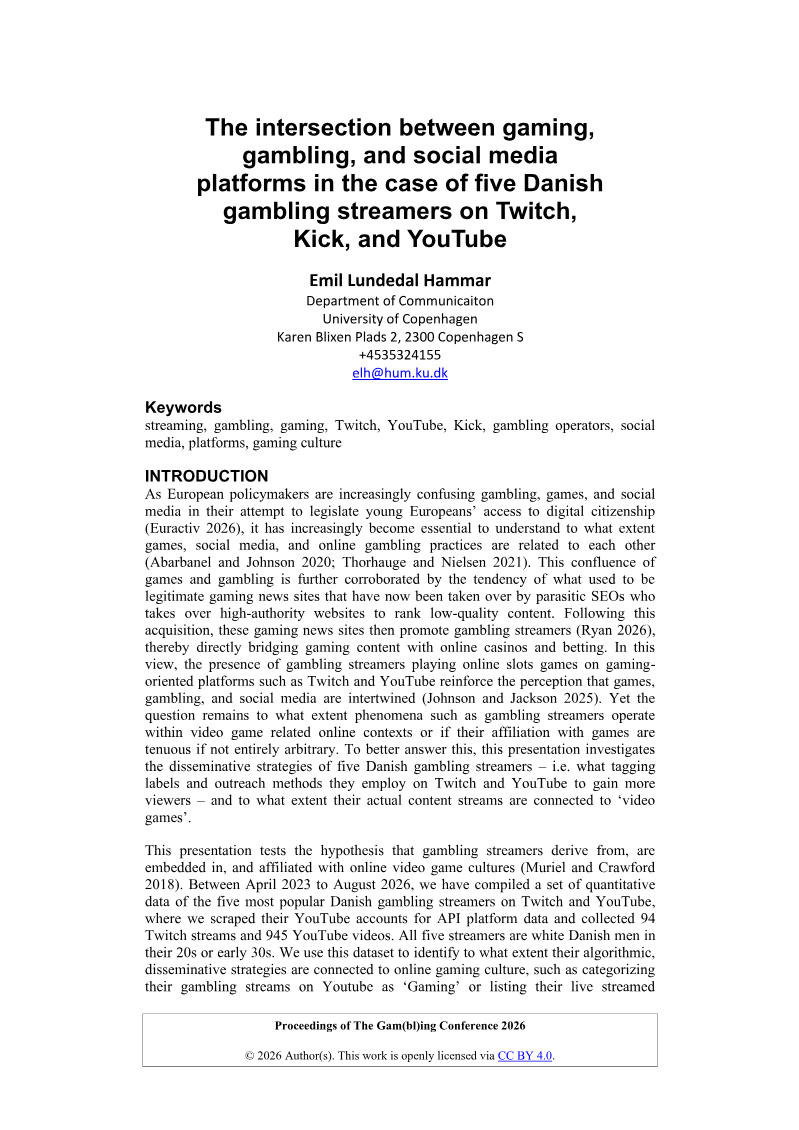
The Intersection Between Gaming, Gambling, and Social Media Platforms: The Case of Five Danish Gambling Streamers on Twitch, Kick, and
This presentation investigates the relationship between gaming, gambling, and social media platforms by analyzing the disseminative strategies and content of five prominent Danish gambling streamers on Twitch and YouTube.
- The paper tests whether Danish gambling streamers are substantively tied to video game culture or only superficially linked to it, motivated by European policy concern over the blurring of gaming, gambling, and social media.
- The study examines five of Denmark's most popular gambling streamers (all white men in their twenties or early thirties) across Twitch, Kick, and YouTube from April 2023 to August 2026, combining 94 Twitch streams and 945 YouTube videos with 233 hours of qualitative footage.
- All four streamers categorized in the analysis label their YouTube gambling videos as "Gaming" and set them to an 18-plus restriction, which the author suggests helps them avoid penalties from Danish gambling authorities.



Disco Elysium: Existential Reflection within Crisis
This paper examines Disco Elysium, the Estonian role-playing game developed by ZA/UM and released in 2019, as a case study in how digital games can facilitate existential reflection on crisis, agency, failure, and identity.
- The paper uses Disco Elysium (ZA/UM, Estonia, 2019) as a case study of how games can prompt existential reflection on crisis, agency, failure, and identity, and argues this design intent is substantively realized in player engagement.
- The methodology combines a critical playthrough, textual analysis, thematic analysis of six developer interview transcripts, and 100 posts and 904 comments from the r/DiscoElysium subreddit.
- Developer interviews yielded four core design priorities: social and political context, emotions, freedom, and mistakes and ownership.
Playful Practices in Ancient Greek Philosophy
Sebastian Weichelt's "Playful Practices in Ancient Greek Philosophy" challenges the longstanding assumption, associated with Johan Huizinga, that play and rationality are opposites.
- Sebastian Weichelt argues that play and rationality are not opposites, since rationality has several distinct forms (instrumental, economic, procedural, epistemic, critical) under which play can be considered rational.
- The central thesis is that the core intellectual practices of ancient Greek philosophy were forms of play, examined through Aristotle's contemplation, sophistic debate, Socratic dialogue, and thought experiments.
- Socratic dialogue and theoretical contemplation satisfy Johan Huizinga's criteria for play and reflect Thomas Henricks' notion of joyful inquiry.
Bride, Demon or Alien? Undressing Stigma in Catherine: Full Body
This work-in-progress paper examines how digital games can foster affective engagement with characters in order to explore social stigma, focusing on the stigmatized theme of infidelity in romantic relationships.
- The paper argues that players' emotional responses to fictional characters are part of wider social practices, and that games can prompt reflection on stigma by letting players act on stereotypical notions of character traits.
- It uses a textual analysis of the 2019 Japanese game Catherine: Full Body, applying a reader-response framework adapted to games' ergodic structure, focusing on the stigmatized theme of infidelity in romantic relationships.
- The game's three female-presenting characters (Catherine, Katherine, and Rin) are examined through its "system of affection," which makes player choices visible as consequences of their engagement.