Toho Holdings
Game Co.2 documents
Documents
Financial15 pages
Financial Results for the First Half of Fiscal Year Ending March 2017: Toho Holdings
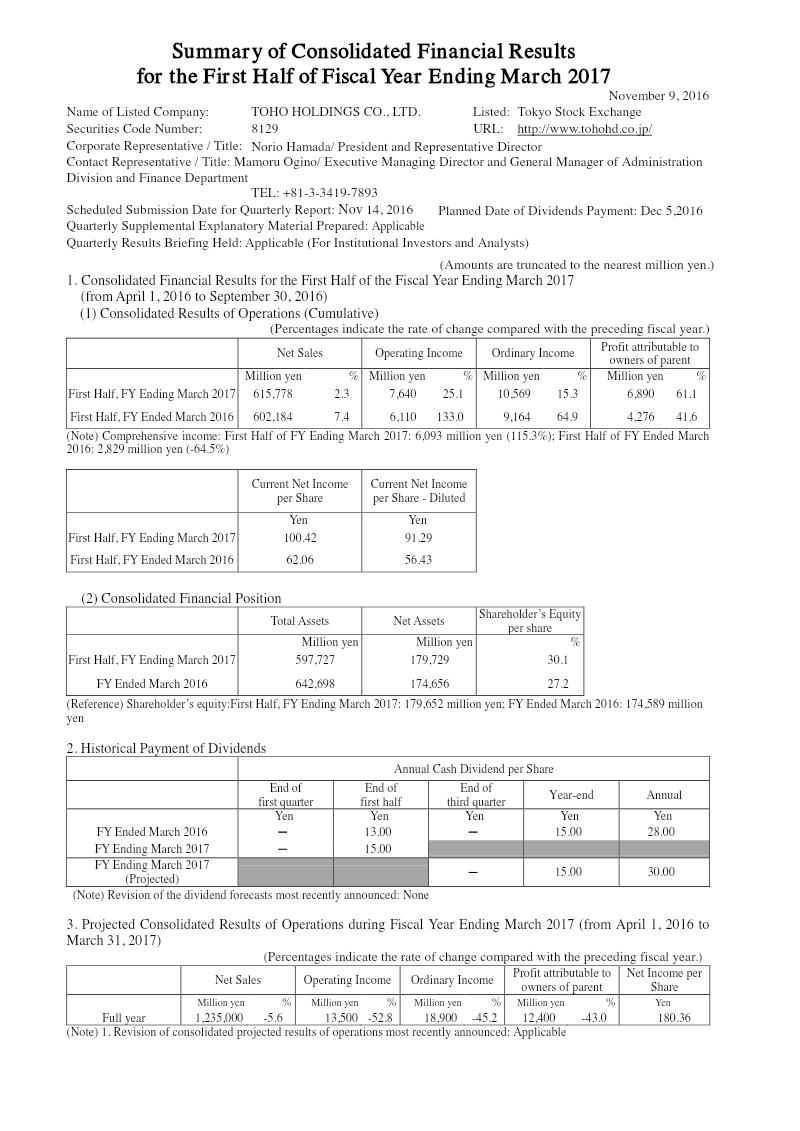
Toho Holdings reported its consolidated financial results for the first half of the fiscal year ending March 2017, covering the period from April 1, 2016, to September 30, 2016. The primary objective of the report is to detail the company’s operational performance and financial position amidst a challenging regulatory environment characterized by national health insurance drug price reductions and revisions to medical service fee systems.
The company achieved net sales of 615,778 million yen, representing a 2.3% increase compared to the same period in the previous year. Operating income rose significantly by 25.1% to 7,640 million yen, while profit attributable to owners of the parent surged by 61.1% to 6,890 million yen. The pharmaceutical wholesaling segment served as the primary driver of growth, posting 591,687 million yen in sales and a 49.0% increase in segment income, bolstered by strong demand for hepatitis C and cancer treatments, alongside the expansion of customer support systems. Conversely, the dispensing pharmacy business faced headwinds, with segment income declining by 79.7% due to the impact of price revisions and difficulties in improving productivity.
The financial position remains stable, with total assets of 597,727 million yen and a shareholder equity ratio of 30.1%. Cash flow from operating activities improved to an inflow of 17,233 million yen, a marked recovery from the previous year. The company also noted a change in accounting policy regarding the depreciation of structures and facilities attached to buildings, shifting from the declining-balance method to the straight-line method in accordance with 2016 tax reforms. Moving forward, the company has revised its full-year earnings forecasts to reflect the performance trends observed during the first half of the fiscal year.
- Toho Holdings reported a 61.1% surge in profit attributable to owners of the parent to 6,890 million yen for the first half of the fiscal year ending March 2017.
- Operating income grew by 25.1% to 7,640 million yen, while net sales increased by 2.3% to 615,778 million yen compared to the same period in the previous year.
- The pharmaceutical wholesaling segment drove growth with 591,687 million yen in sales and a 49.0% increase in segment income, fueled by strong demand for cancer and hepatitis C treatments.
- The dispensing pharmacy business experienced a significant 79.7% decline in segment income, attributed to medical service fee revisions and productivity challenges.
- Cash flow from operating activities reached an inflow of 17,233 million yen, marking a recovery from the previous year, while the shareholder equity ratio stood at 30.1%.
TOHO HOLDINGS CO.
Financial14 pages
Financial Results for the First Half of Fiscal Year Ending March 2019: Japan
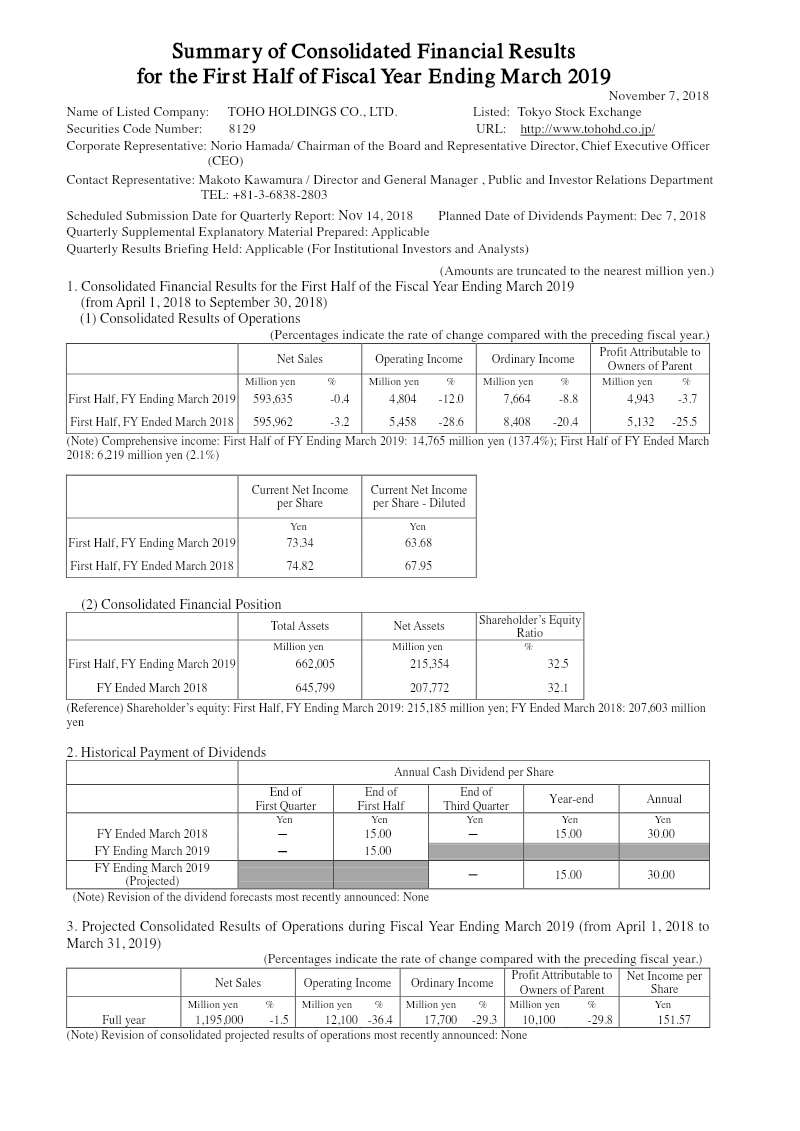
Toho Holdings Co., Ltd. reported its consolidated financial results for the first half of the fiscal year ending March 2019, covering the period from April 1, 2018, to September 30, 2018. The company operates primarily within the Japanese medical, healthcare, and nursing care sectors. During this period, the pharmaceutical industry faced significant headwinds, including a 7.48% reduction in National Health Insurance (NHI) drug prices and broader reforms to the drug pricing system.
Financial performance for the first half showed a slight contraction compared to the previous year. Net sales reached 593,635 million yen, a 0.4% decrease, while operating income fell by 12.0% to 4,804 million yen. Ordinary income and profit attributable to owners of the parent also declined by 8.8% and 3.7%, respectively. Within the business segments, pharmaceutical wholesaling remained the primary revenue driver, posting 571,243 million yen in net sales and a 9.9% increase in segment income. Conversely, the dispensing pharmacy business experienced a sharp decline in profitability, with segment income dropping 84.5% to 201 million yen due to dispensing fee revisions.
The company continues to focus on a business model centered on value-added services and the establishment of community comprehensive healthcare systems. Strategic initiatives during this period included the launch of a new operation base in the Hokuriku region and the opening of a highly functional distribution center in Hiroshima to enhance productivity and disaster resilience. Additionally, the company is expanding its generic drug presence through Kyosomirai Pharma Co., Ltd. Despite the challenging operating environment, management maintained its full-year earnings projections, citing no changes to the forecasts previously announced in May 2018.
- Toho Holdings reported a 0.4% decline in net sales to 593,635 million yen and a 12.0% drop in operating income to 4,804 million yen for the first half of the fiscal year ending March 2019.
- The dispensing pharmacy business saw a sharp 84.5% decline in segment income to 201 million yen, primarily driven by government-mandated dispensing fee revisions.
- Pharmaceutical wholesaling remained the company's core revenue driver with 571,243 million yen in net sales and a 9.9% increase in segment income.
- Financial results were negatively impacted by a 7.48% reduction in National Health Insurance (NHI) drug prices and broader reforms to the Japanese drug pricing system.
- Management maintained its full-year earnings projections as originally announced in May 2018, despite the challenging operating environment.
+1
TOHO HOLDINGS CO.Nov 2018