University of Lausanne
Organization2 reports
2 reports, presentations and talks by University of Lausanne in the Game Industry Library, the newest “Smaky Story: A Comprehensive Approach of Computing in French-Speaking Switzerland” (2023).
Documents
Whitepaper4 pages
Smaky Story: A Comprehensive Approach of Computing in French-Speaking Switzerland
This doctoral research proposal, presented at a PhD consortium, sets out to examine the Smaky microcomputers, a series of Swiss machines developed in a laboratory of the Swiss Federal Institute of Technology Lausanne in the 1970s and marketed in French-speaking Switzerland until the late 1990s.
- The report is a PhD research proposal examining the Smaky microcomputers, a series of Swiss machines developed at the Swiss Federal Institute of Technology Lausanne (EPFL) in the 1970s and sold in French-speaking Switzerland until the late 1990s.
- The project addresses a gap in scholarship: the Smaky's role in Swiss computing and video game heritage has received little academic attention and currently rests mainly on enthusiasts, journalists, and former engineers.
- The research is framed as a four-year initiative called Confederatio Ludens, with PhD work beginning in February 2023.
DiGRAJun 2023
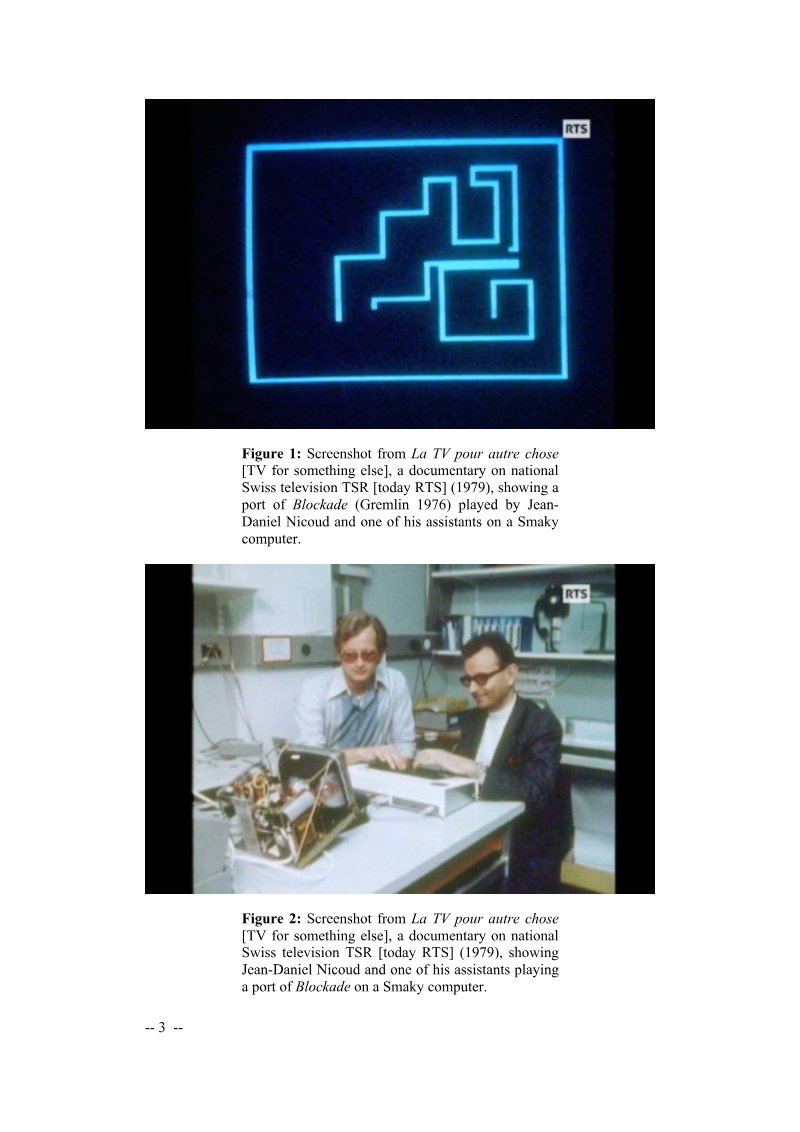
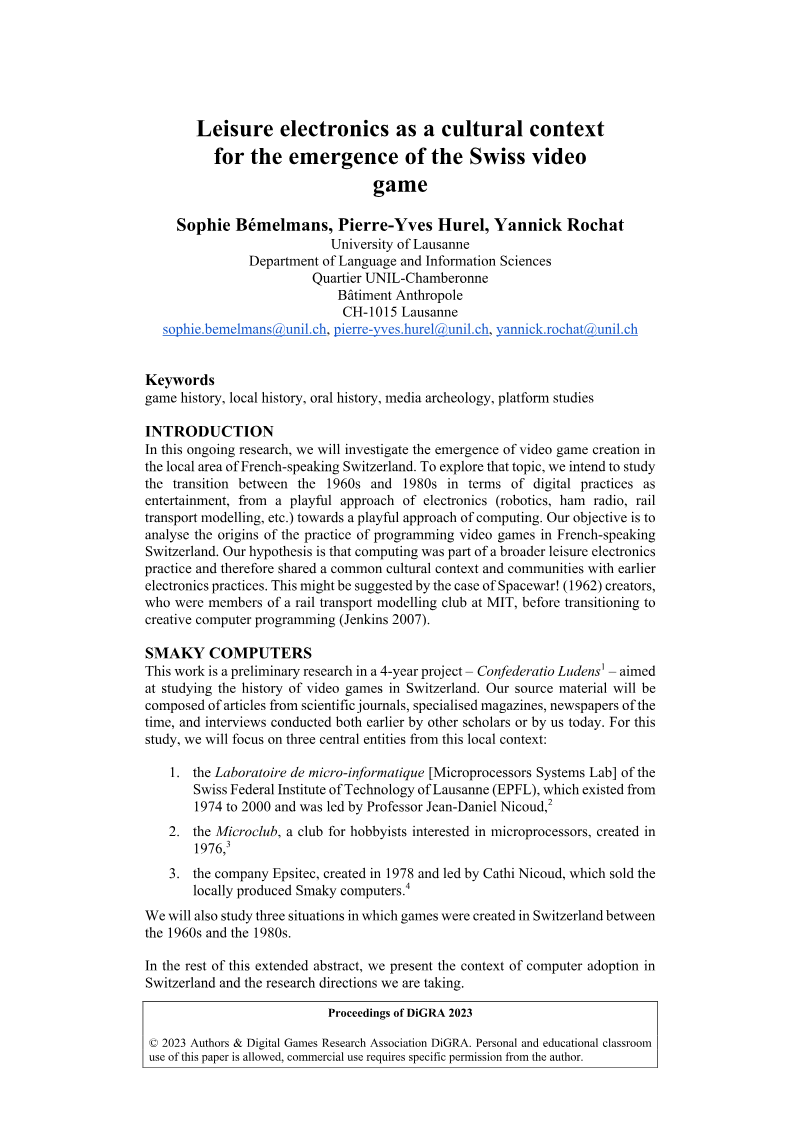
Whitepaper5 pages
Leisure Electronics as a Cultural Context for the Emergence of the Swiss Video Game
This extended abstract, presented at DiGRA 2023, outlines an early-stage research project examining how video game creation emerged in French-speaking Switzerland between the 1960s and 1980s.
- The paper argues that Swiss video game creation grew out of a broader leisure electronics culture, including robotics, ham radio, and model railways, and shared communities and practices with those hobbies.
- It draws a parallel with Spacewar! at MIT, whose creators came from a railway modelling club, to support the hypothesis that hobby communities seeded early game programming.
- The study focuses on three local entities: the Microprocessors Systems Lab at EPFL led by Jean-Daniel Nicoud, the Microclub hobbyist association founded in 1976, and the company Epsitec, which sold locally produced Smaky computers under Cathi Nicoud's leadership.
University of LausanneJun 2023