Showing 30 of 109 results · 0.20s
Jan 2023
Global Gaming Report 2023: Investment & M&A Overview
Drake Star Partners
points covering North America, Europe, and Asian markets, particularly Japan, Korea, and China. Public market performance showed a gradual recovery, with the Drake Star Gaming Index rising
Financial24 pages
May 2026
Business Review: January–March 2026
Remedy Entertainment
liquidity cushion. Geographically, Remedy operates globally with a focus on core markets and expanding presence in China and Latin America through targeted marketing campaigns for CONTROL Resonant
Financial20 pages
Jun 2010
NetEase.com, Inc. Form 20‑F (FY2009)
NetEase
significant R&D investment (RMB 230 m) and a dedicated marketing force. Geographically, all operations are China‑based, with revenue generated through portal traffic, game subscriptions, and advertising
Financial1 pages
Jan 2025
Financial Results for the First Quarter of the Fiscal Year Ending March 2026
Koei Tecmo
American and European markets while focusing on mobile dominance in Japan and China. Emerging markets in India and Southeast Asia are also being targeted for research and development
Financial18 pages
Annual Report 2024: Tencent Holdings Limited
Tencent
market competition, regulatory compliance, and technological volatility. Geographically, the Mainland of China remains the primary market, accounting for roughly 90% of total revenue. To operate within this regulatory
Financial274 pages
Jun 2005
Gravity Co. 20‑F: Fiscal Year Ended December 31, 2004
Gravity Co.
majority of revenue overseas, where licensing agreements in Japan, Taiwan, Thailand, China, and other markets provided upfront fees and ongoing royalties. Operating income climbed to US$38.4 million
Financial1 pages
Consolidated Financial Results for the Six Months Ended June 30, 2026
NEXON Co.
Geographically, the company experienced a strategic shift in its market performance. While traditional strongholds in Korea and China saw declines, significant growth in North American and European markets
Financial26 pages
Aug 2025
Corporate Data: As of August 31, 2025
Square Enix
branches in China and India. Square Enix (China) Co., Ltd. and Huang Long Co., Ltd. manage digital entertainment and online game sales within the Chinese market, while Square
Financial1 pages
FY2015 Third Quarter Financial Results
GREE
user engagement across its game portfolio. The document covers Japan, U.S., Europe, and China markets over FY2015, employing quarterly financial statements, cost‑structure analysis, headcount data
Financial30 pages
Sep 2019
Integrated Report 2019
Bandai Namco
large‑scale experiences (e.g., 18‑m moving Gundam slated for 2020). • Target markets: China, North America (localised content). Dragon Ball • YouTube masthead campaign → 17 M+ views
Financial114 pages
Nov 2024
NVIDIA Form 10-Q: Q3 Fiscal Year 2025
NVIDIA
controls on high-performance AI semiconductors continue to restrict access to key markets, including China and the Middle East, necessitating complex licensing strategies and supply chain adjustments. These
Financial1 pages
Jul 2014
Square Enix Annual Report FY2014
Square Enix
particularly in the JRPG genre, while aggressively expanding into high-growth mobile markets in China, India, and South America. Despite a ¥1.7 billion extraordinary loss from a review
Financial74 pages
Aug 2024
Form 10-Q: Q2 Fiscal Year 2025
NVIDIA
evolving U.S. export controls that restrict high-performance chip sales in key markets like China. These regulatory pressures, combined with the inherent difficulty of forecasting AI-driven demand
Financial1 pages
Jan 2014
Fiscal Year Ending March 2015 Financial Results
Koei Tecmo
Business Promoting Division. Geographically, there is a concerted effort to penetrate Asian markets, specifically China and Korea, across both console and mobile platforms. This international outlook extends
Financial38 pages
Aug 2024
Tencent Holdings Limited Interim Report 2024
Tencent
earlier, reflecting higher monetisation of gaming, digital content and cloud services across China and overseas markets. The balance sheet strengthened, with total assets climbing
Financial122 pages
Apr 2015
NetEase Annual Report: 2014
NetEase
insight into the firm’s financial health. Management commentary addresses strategic initiatives, market dynamics in China and international operations, and risk factors affecting future performance. The filing includes
Financial1 pages
Financial Results for the Fourth Quarter of FY2011
GREE
Japan and a growing presence in the United States, Europe, China, and other Asian markets. The acquisition of OpenFeint added 50 million users and broadened GREE’s reach
Financial25 pages
Aug 2017
Summary of Financial Results for First Half of Fiscal Year Ending December 31, 2017
KLab
data analysis and consulting capabilities within the competitive mobile gaming markets of Japan and China. Methodologically, the report utilizes Japanese GAAP and introduces a range-based forecasting model
Financial13 pages
Apr 2019
Huya Annual Report on Form 20‑F for FY2018
Huya
securing regulatory approvals, managing VIE risks, and navigating intense competition within China’s live‑streaming market
Financial1 pages
Aug 2023
NVIDIA Quarterly Report: Form 10-Q (Q2 FY2024)
NVIDIA
export controls on AI-related semiconductors pose a direct risk to market access, particularly in China, and threaten to disrupt established supply chains. Although the company has implemented
Financial1 pages
Annual Results Announcement: 2025
XD
roles. These results reflect a period of operational consolidation and international market penetration for the China-based firm. The financial figures, which have been reviewed by the Audit
Financial44 pages
Jun 2014
FY2014 Business Report
mixi
Geographically, the company is focused on the Japanese market while aggressively expanding into Greater China. Following a May 2014 launch in Taiwan, mixi established a partnership with Tencent
Financial2 pages
FY2019 Fourth Quarter Financial Results Briefing
GREE
million. Geographically, the firm expanded into key Asian markets—including Hong Kong, Taiwan, and China—while launching titles in North America and Europe. Distribution strategy emphasizes self‑distribution
Financial5 pages
2008 Annual Report
Tencent
Overall, Tencent’s 2008 performance underscored its dominant position in China’s internet and mobile services market, delivering robust revenue growth, profitability, and shareholder returns amid a challenging
Financial170 pages
Mar 2026
FY 2025 Results Presentation
tinyBuild
disposal of Red Cerberus. Geographically, the company targets global markets with a particular emphasis on China, where localisation contributed to roughly 40 % of sales. The pipeline includes seven
Financial27 pages
Mar 2017
Annual Report of 11 bit studios S.A. for 2016
11 bit studios
revenue generated outside Poland. The United States remains the primary market at 77.8% of sales, while China has emerged as the second-largest region. The Group maintained
Financial86 pages
Oct 2024
Financial Results for the First Half of the Fiscal Year Ending March 2025
Koei Tecmo
focus, with strengthened publishing infrastructures in North America, Europe, and China, alongside targeted entry into emerging markets in Southeast Asia and India. While domestic Japanese revenue is expected
Financial51 pages
Jun 2008
Gravity Co., Ltd. Form 20-F: Fiscal Year Ended December 31, 2007
Gravity Co.
Japan (47% of revenue), and the U.S./Canada, with additional markets in Taiwan, Hong Kong, Thailand, and China. Currency exposure is substantial—approximately 72% of revenue in USD/JPY
Financial1 pages
Tencent 2026 First Quarter Results Presentation
Tencent
transition toward AI-centric operations while maintaining leadership in China’s mobile community and digital content markets
Financial25 pages
Apr 2017
Annual Report Pursuant to Section 13 or 15(d) of the Securities Exchange Act of 1934: NetEase
NetEase
online gaming, e‑commerce, and digital media services primarily in China, with a growing presence in international markets. Key financial highlights for FY2016 include revenue of approximately
Financial1 pages
Global Gaming Report 2023: Investment & M&A Overview
Jan 202324 pages0k words
Summary
The global gaming industry experienced a significant year for deal-making in 2023, characterized by record-breaking transaction values and a return to pre-pandemic activity levels. Total disclosed deal value for closed transactions reached $86 billion, a figure heavily influenced by the $69 billion acquisition of Activision Blizzard by Microsoft. Despite a broader market stabilization, the industry saw 960 announced deals throughout the year, with a total disclosed value of approximately $20 billion.
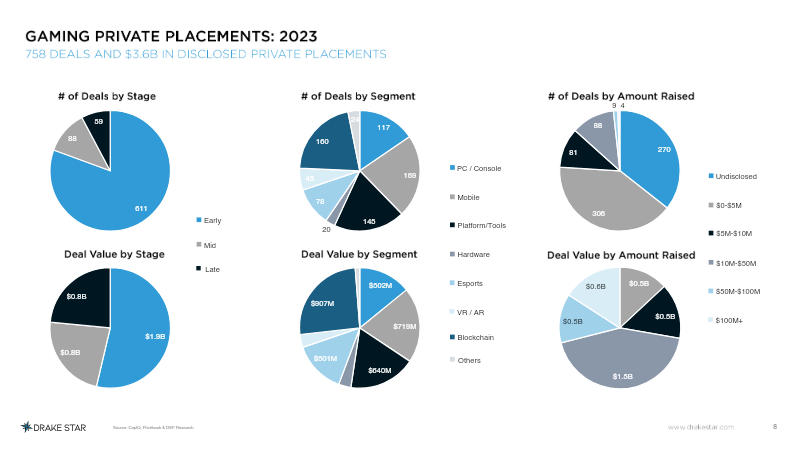
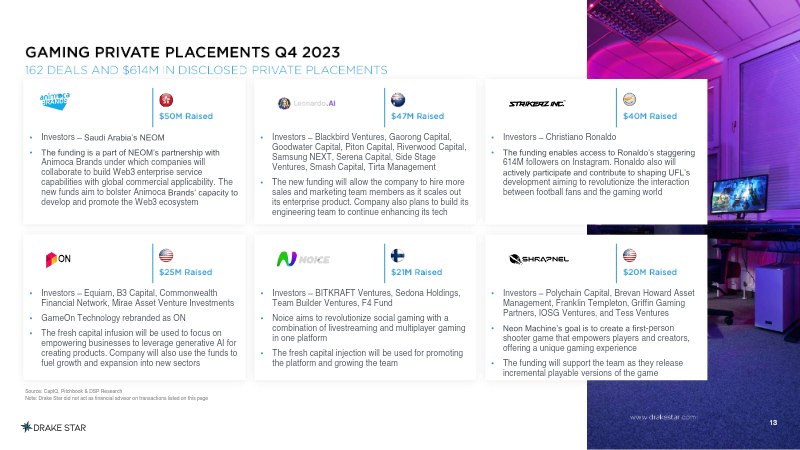
Mergers and acquisitions were particularly robust in the PC and console segments, which saw 44 deals, followed closely by mobile with 37. Notable transactions included Savvy Games Group’s $4.9 billion acquisition of Scopely and Tencent’s majority stake in Techland for $1.6 billion. Private financing remained steady, with over $3.5 billion raised across more than 750 rounds. While mobile led financing activity, blockchain and platform tools remained high-interest areas for venture capital firms such as Bitkraft and Andreessen Horowitz. Investors showed a clear preference for early-stage opportunities, with over 85% of fourth-quarter financings directed toward seed and early-stage companies.
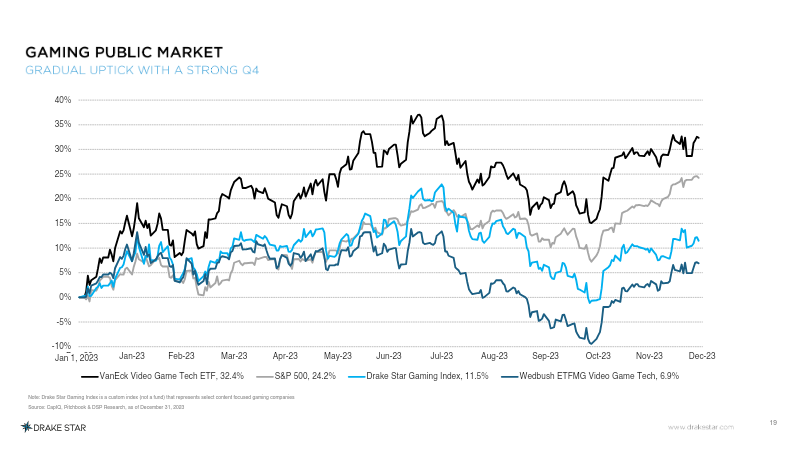
The geographic scope of the analysis is global, with significant data points covering North America, Europe, and Asian markets, particularly Japan, Korea, and China. Public market performance showed a gradual recovery, with the Drake Star Gaming Index rising 11.5% over the year.
Looking toward 2024, the outlook suggests a steady increase in M&A activity, driven by strategic buyers like Tencent, Sony, and Savvy Games Group. Market trends indicate a shift toward smaller and mid-sized deals, a continued focus on artificial intelligence and VR/AR tools, and a potential resurgence of initial public offerings in the latter half of the year as public valuations improve. Private equity is expected to play a larger role in taking undervalued public companies private, while entrepreneurs are increasingly prioritizing early profitability over long-term growth.
Pages

Insights
- The global gaming industry recorded $86 billion in total closed transaction value in 2023, largely driven by Microsoft’s $69 billion acquisition of Activision Blizzard.
- Beyond mega-deals, the industry saw 960 announced transactions totaling $20 billion, with robust M&A activity in PC/console (44 deals) and mobile (37 deals).
- Private financing remained active with over $3.5 billion raised across 750+ rounds, with 85% of Q4 funding directed toward seed and early-stage companies.
- Public market performance showed recovery, as evidenced by an 11.5% increase in the Drake Star Gaming Index over the course of the year.
- Strategic buyers including Tencent, Sony, and Savvy Games Group are expected to drive a shift toward smaller and mid-sized M&A deals in 2024.
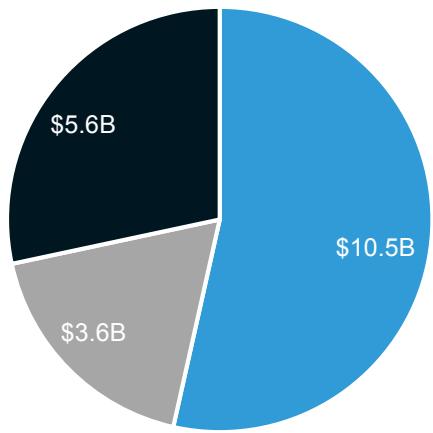
This pie chart from a game industry report illustrates the distribution of revenue across three segments, totaling $19.7 billion. The largest segment accounts for $10.5 billion, followed by $5.6 billion, and the smallest segment at $3.6 billion.
Showing 1 – 30 of 109