FinancialKanematsu Corporation
Highlights of Consolidated Financial Results: First Half, Fiscal Year Ending March 2016
1 pages~8 min full read
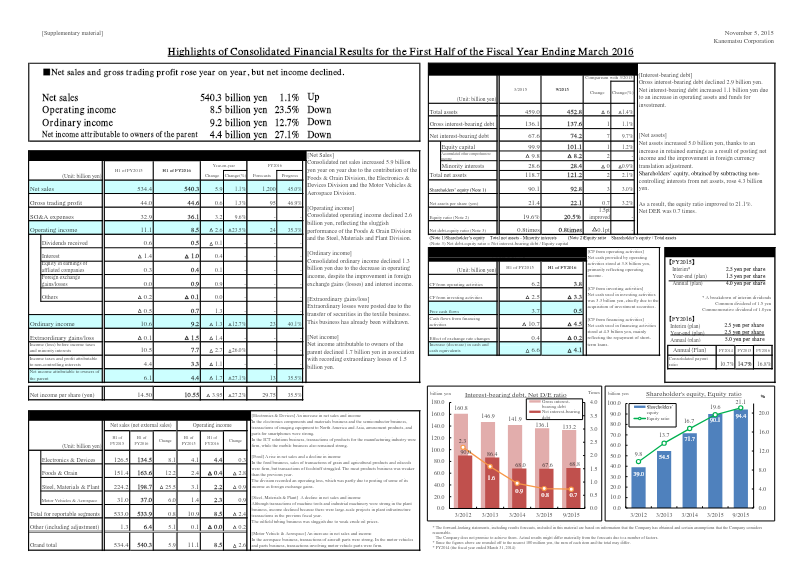
Kanematsu Corporation reported a 1.1% year-on-year increase in net sales to 540.3 billion yen for the first half of fiscal year 2016, despite a 23.5% decline in operating income to 8.5 billion yen.
Net income attributable to owners of the parent fell 27.1% to 4.4 billion yen, largely due to 1.5 billion yen in extraordinary losses incurred from exiting the textile business.
The Electronics & Devices division was the primary growth driver, reporting increases in both sales and income fueled by demand for smartphone components, imaging equipment, and ICT solutions.
Profitability was negatively impacted by the Steel, Materials and Plant division, which suffered from low crude oil prices affecting oilfield tubing and a lack of large-scale infrastructure projects.
The Foods & Grain division experienced a margin squeeze, reporting higher sales but lower income due to weak performance in feedstuff and meat product transactions.
The company maintained a stable financial position with an improved equity ratio of 21.1% and a net debt-to-equity ratio of 0.7 times.
Management plans to maintain an annual dividend of 5.0 yen per share for the full fiscal year despite the overall contraction in profitability.
Kanematsu Corporation’s consolidated financial results for the first half of the fiscal year ending March 2016 reflect a period of mixed performance characterized by top-line growth alongside a contraction in profitability. While consolidated net sales rose to 540.3 billion yen—a 1.1% increase year-on-year—operating income fell by 23.5% to 8.5 billion yen. This decline in profitability was primarily driven by sluggish performance within the Foods & Grain and the Steel, Materials and Plant divisions. Furthermore, net income attributable to owners of the parent decreased by 27.1% to 4.4 billion yen, impacted by 1.5 billion yen in extraordinary losses related to the withdrawal from the textile business.
Segment performance varied significantly across the company’s portfolio. The Electronics & Devices division reported growth in both sales and income, bolstered by strong demand for imaging equipment, smartphone components, and ICT solutions. Conversely, the Foods & Grain division saw increased sales but lower income due to weakness in meat products and feedstuff transactions. The Steel, Materials and Plant division experienced a decline in both metrics, attributed to the absence of large-scale plant infrastructure projects from the previous year and the negative impact of low crude oil prices on the oilfield tubing business.
Despite the decline in net income, the company’s financial position remained stable. Total net assets increased to 121.2 billion yen, supported by retained earnings and favorable foreign currency translation adjustments. The equity ratio improved to 21.1%, and the company maintained a disciplined approach to capital, with a net debt-to-equity ratio of 0.7 times. Cash flow from operating activities provided 3.8 billion yen, while net cash used in investing activities reached 3.3 billion yen, largely due to the acquisition of investment securities. The company continues to prioritize shareholder returns, planning an annual dividend of 5.0 yen per share for the full fiscal year.