Salary has overtaken flexible work as the primary driver for career moves, with 31% of UK and Western European respondents citing higher pay as their main reason for leaving a position.
See it on page 30Artist compensation has seen a sharp 35% increase between 2021 and 2023, with mid-level artists now earning approximately £75k.
See it on page 55Project close-out periods are a critical retention risk, as 22% of UK respondents decline new offers to finish current projects and 46% of global staff are actively job hunting.
See it on page 2Remote work remains a baseline expectation for the industry, with 92% of global respondents requiring at least one remote day per week and 91% of Eastern European staff working remotely.
See it on page 45Global compensation ranges are broad, with junior programmers earning between £25k–£50k and senior or managerial roles reaching up to £200k in specific markets.
See it on page 47Beyond salary, the most highly valued employee benefits are private health care (41%), pension plans (39%), and flexible or remote working arrangements (16–19%).
See it on page 24The ninth‑year Games & Interactive Salary & Satisfaction Survey demonstrates that financial remuneration has become the predominant catalyst for career moves, eclipsing flexible or remote work as a primary motivator. Across the United Kingdom and Western Europe, 31 % of respondents cite higher pay as their main reason for leaving a position, while culture and benefits remain significant secondary drivers. In Eastern Europe, remote working is almost universal (91 %) yet salary still leads the list of motivations for job changes. The survey’s high response rate allows a granular view of compensation trends, revealing junior programmers earning £25‑£50 k globally and senior or managerial roles reaching up to £200 k in certain markets.
A notable trend is the heightened turnover during project close‑out periods, with 22 % of UK respondents declining offers to finish current projects and a global job‑hunt rate of 46 %. This suggests studios must strengthen retention strategies once projects conclude. Remote work expectations are high, with 92 % of global respondents anticipating at least one remote day per week, and flexible/remote working remains a top benefit sought (16‑19 % across regions).
Artist compensation has risen sharply, with average salaries increasing 35 % from 2021 to 2023. Mid‑level artists now earn around £75 k, while senior and lead roles approach £50 k. Remote work is preferred by 76 % of artists, and private health care (41 %) and pension plans (39 %) are the most valued benefits. Technical artists show lower job‑hunting activity compared to concept or character artists, indicating varying stability across creative roles. Overall, the survey underscores a cost‑of‑living pressure that prioritizes pay, while culture, flexibility, and robust post‑project retention remain critical for talent attraction and retention across the global games industry.
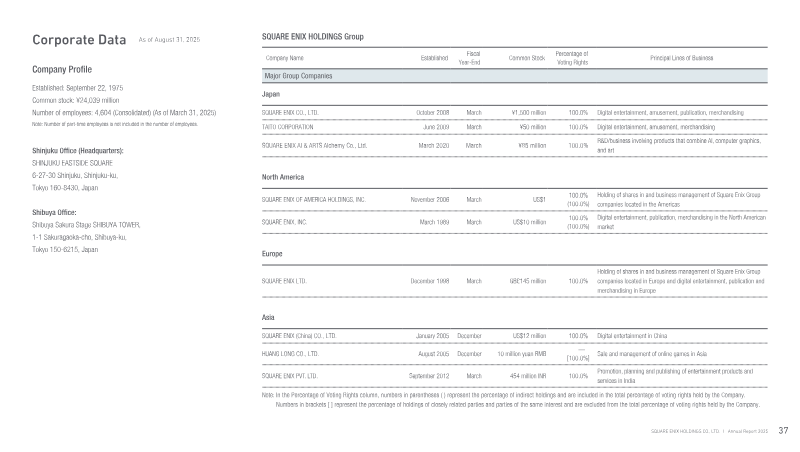
The Square Enix Holdings Group maintains a robust global infrastructure centered on digital entertainment, amusement, publication, and merchandising. As of August 31, 2025, the organization operates with a consolidated workforce of 4,604 employees and a common stock valuation of 24,039 million yen. The corporate structure is defined by a series of wholly owned subsidiaries that manage regional operations across Japan, North America, Europe, and Asia, ensuring a localized approach to publishing and service management. The Japanese core consists of Square Enix Co., Ltd. and Taito Corporation, which handle the primary development and amusement sectors, alongside specialized entities like Square Enix AI & Arts Alchemy. This latter subsidiary focuses on research and development at the intersection of artificial intelligence and computer graphics. International operations are segmented by geography, with Square Enix of America Holdings and Square Enix Ltd. overseeing the North American and European markets, respectively. These entities manage the distribution of digital content and physical merchandise while providing business management for their respective territories. Expansion into Asian markets is facilitated through dedicated branches in China and India. Square Enix (China) Co., Ltd. and Huang Long Co., Ltd. manage digital entertainment and online game sales within the Chinese market, while Square Enix Pvt. Ltd. focuses on the promotion and publishing of entertainment services in India. This organizational framework demonstrates a strategic commitment to global diversification, utilizing a network of 100% voting right subsidiaries to maintain strict brand control while scaling operations across diverse regulatory and consumer landscapes.