Updated Mar 17, 2026 by Modern Times Group
Financial · January 1, 2012
Published by Modern Times Group
The 2012 annual report presents Modern Times Group AB’s financial performance, strategic actions and sustainability initiatives, positioning the company as a financially robust, diversified media operator seeking growth through acquisitions and digital expansion. Net sales reached SEK 13.3 billion, operating profit rose to SEK 2.1 billion and net profit recovered to SEK 1.6 billion, delivering basic earnings per share of SEK 17 after a loss‑making 2011. Free‑cash‑flow increased 6 % to SEK 1.8 billion, enabling a 20 % dividend rise to SEK 600 million and leaving net debt essentially at zero, while capital spending remained modest at 1 % of revenue. Revenue growth was uneven across segments. Nordic pay‑TV sales grew 4 % to SEK 4.4 billion with a 4 % lift in ARPU, yet operating profit fell; free‑TV Scandinavia declined 4 % and margins contracted. In contrast, emerging‑market free‑TV sales were flat on a constant‑currency basis but operating profit surged nearly five‑fold, reflecting the impact of new pay‑TV investments. The year featured several strategic acquisitions—including TV Sport, a majority stake in Zitius Service Delivery, Paprika Latino and Latvia’s Latvijas Neatkarīgā Televīzija—and the divestiture of Bet24
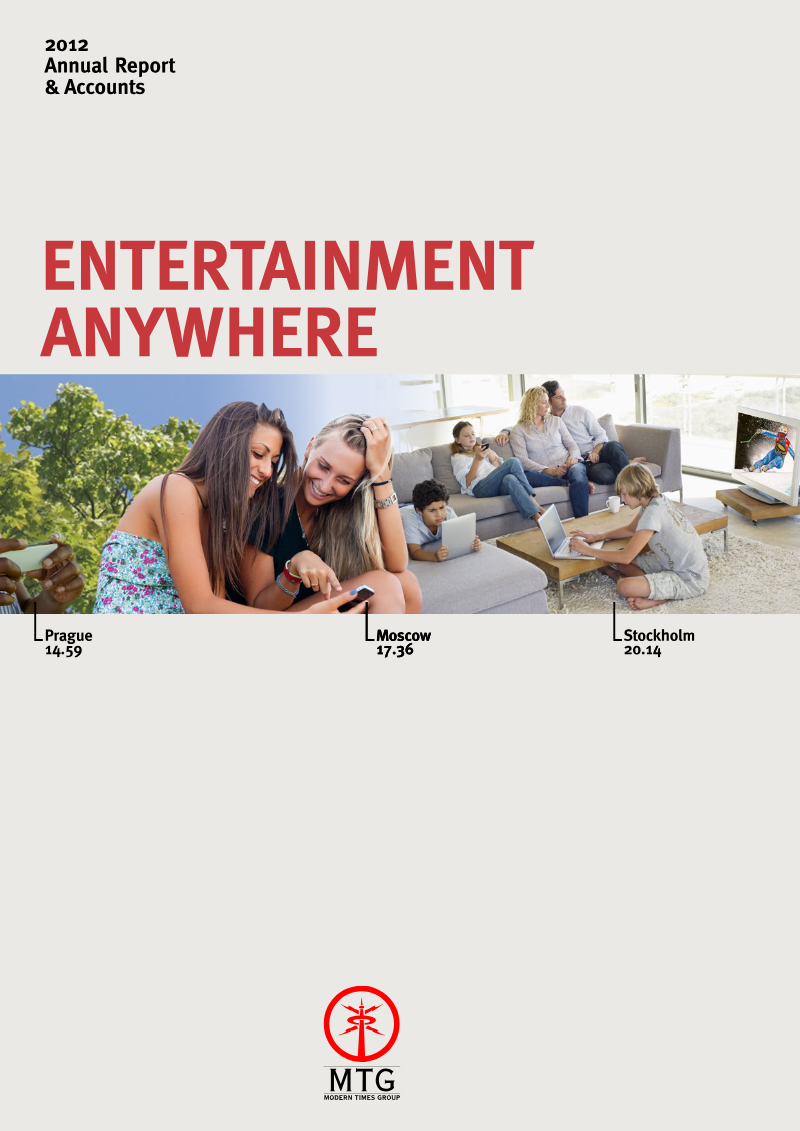
Annual Report & Accounts ENTERTAINMENT ANYWHERE Prague Moscow 14.59 Moscow Stockholm 17.36 17.36 20.14
Content Contents CEO’s Review 1 CFO’s Review 4 Five Year Summary 6 Modern Responsibility 10 Directors’ Report 16 The MTG Share 46 Corporate Governance Report 50 Board of Directors 60 Executive Management 63 Consolidated Financial Statements 67 Parent Company Financial Statements 72 Notes to the Accounts 77 Audit Report 128 Definitions 130 Glossary 131
CEO’s review CEO’s review This is my first annual review since taking over as CEO of MTG in September last year, but this is my nineteenth year at MTG, and my eleventh as a member of the senior management group. I have never stopped learning at MTG and now more than ever, as I have travelled around the operations over the past few months to learn more about the parts of the Group that I had not previously reached, and to understand what we offer our customers in each area. This has been an inspiring journey, meeting with a large number of our 3,191 employees from Accra to Helsinki, and London to Kyiv. Each market has its own unique characteristics, but it is great to see that our entrepreneurial way of doing business not only embraces this diversity, but actually harnesses it. The colleagues that I meet share the same passion for our business and our customers; they continually demonstrate the same innovation when it comes to solving problems and identifying opportunities; and they take the same pride in craftsmanship when creating, developing and promoting the entertainment products and services that our customers enjoy around the world. A lot has been said about the uncertain economic outlook in our markets, the impact of technology on consumer behavior, and the fact that our industry is changing faster and more fundamentally than ever before. This is our daily reality, and everything that we do is focused on building the media house of the future, in order to ensure that we constantly innovate to remain at the forefront of our industry and continue to grow.
t that our industry is changing faster and more fundamentally than ever before. This is our daily reality, and everything that we do is focused on building the media house of the future, in order to ensure that we constantly innovate to remain at the forefront of our industry and continue to grow. The media house of the future is your house, it is the way that you will consume, use, more closer to, and immerse yourself in, entertainment in the future. TV is now available on multiple devices and is mobile – both in and out of the home. So you can now choose between the TV set, the computer, the smartphone, the tablet and the games console... TV is also available on-demand as well as on a linear (scheduled) basis, so viewers are not only choosing what they want to watch but also when they want to watch it. This of course affects the business model in a number of ways, as advertisers increasingly pay for reach delivered through TV viewing on the internet, and subscribers opt for packages that provide all that they need via the open internet for a monthly fee.
atch but also when they want to watch it. This of course affects the business model in a number of ways, as advertisers increasingly pay for reach delivered through TV viewing on the internet, and subscribers opt for packages that provide all that they need via the open internet for a monthly fee. We are better positioned than anyone to capitalise on these shifts in the industry’s tectonic plates for four reasons – firstly, because we have a balanced mix of advertising and subscription revenues and are not bound by a single business model; secondly, because we are platform agnostic, meaning that we already make our channels and services available on other people’s networks so we benefit from overall industry growth; thirdly, because we are present across four continents so we are able to deploy new products, services and models rapidly and efficiently to an installed and growing customer base; and, fourthly, because we do not own much infrastructure and can therefore move quickly and flexibly without tying up a lot of money in costly long term development projects.
we are able to deploy new products, services and models rapidly and efficiently to an installed and growing customer base; and, fourthly, because we do not own much infrastructure and can therefore move quickly and flexibly without tying up a lot of money in costly long term development projects. All of this provides us with fantastic opportunities, which is why we are investing now and more than ever before. Our investments are focused on three key areas – content, technology and countries. Customer preference and purchasing is driven by three key factors – quality, price and accessibility. The first of these relates to the quality of the content on our channels and platforms, which is why we acted during 2012 to secure long term deals with the major Hollywood and local independent studios and signed multi-year agreements for exclusive access to key domestic and international sports rights. We have invested in technology to ensure that our channels and services are accessible on both
The 2011 Modern Times Group (MTG) Annual Report presents a comprehensive assessment of the company’s financial performance, strategic direction, and governance during a year of record revenue but substantial impairment losses. While net revenue reached SEK 13.5 billion—a 6 % increase at constant exchange rates—and underlying operating profit rose 8 % to SEK 2.5 billion, a SEK 2.998 billion write‑down of the Nova business in Bulgaria and related goodwill impairments drove the consolidated group to a net loss of SEK 1.289 billion and an operating loss of SEK 637 million. Total assets declined to SEK 11.3 billion and equity fell to SEK 4.1 billion, leaving cash and cash equivalents at SEK 96 million despite positive operating cash flow of SEK 1.8 billion. Growth was strongest in emerging‑market television and pay‑TV, which posted 8 % and 13 % increases respectively and lifted the Nordic premium subscriber base above one million. The board expects emerging‑market operations to contribute an expanding share of revenue and profit while preserving robust returns on capital employed and equity, subject to a minimum performance threshold. Nevertheless, the Directors’ Report flags accelerating technological disruption—on‑demand viewing, ad‑skipping, and low‑cost channel launches—as a source of audience fragmentation and heightened piracy risk, necessitating significant investment in broadcasting and satellite infrastructure. Corporate governance is overseen by a twelve‑member board, including eight non‑executive directors and dedicated remuneration, audit and nomination committees, with external audit provided by KPMG and an independent internal audit function. Risk management relies on transaction‑level hedging of programme‑acquisition costs, leaving translation‑level foreign‑
Modern Times Group (MTG) delivered a decisive financial turnaround in 2010, achieving its strategic aim of double‑digit organic growth while reinforcing a balanced capital structure. Net sales rose 12 % to SEK 13.1 bn, driven by strong advertising and subscription performance, and operating income increased 27 % to SEK 2.36 bn, delivering an 18 % margin. The group generated a free‑cash‑flow surplus of SEK 1 bn, converted 70 % of EBITDA into cash, and reduced net debt to roughly SEK 2 bn—below one times EBITDA. A 10 % dividend uplift to SEK 5.50 per share and a proposed 36 % increase for 2011 reflected the improved cash position, while the CDON spin‑off contributed a SEK 1.7 bn non‑cash gain. Content investments, notably Premier League rights, HD/3D and OTT services, together with expanded ownership in Eastern‑European satellite platforms, positioned MTG for continued growth across mature Scandinavian markets and emerging regions. Governance was strengthened through a newly constituted Nomination Committee representing over half the voting rights, an eight‑member board with four independents, and robust audit and internal‑control functions. Shareholder composition was diversified, with Swedish institutions, international investors and private holders each accounting for roughly 40 % of capital, and a share‑buy‑back mandate covering up to 10 % of issued shares. The 2010 financial statements were prepared under IFRS, incorporating recent standard changes that affected earnings per share and income‑statement presentation, and detailed fair‑value treatment of derivatives, assets and liabilities. Risk management emphasized a credit exposure of SEK 2.2 bn, primarily trade receivables, and comprehensive FX hedging via twelve‑month forwards. Although operating cash generation fell sharply to SEK 60 m from SEK 3.3 bn the prior year, interest and tax outflows were halved, underscoring disciplined cost control. Overall, the 2010 results illustrate MTG’s successful transition from a loss‑making position in 2009 to a profitable, cash‑generating, and strategically positioned media group.
Modern Times Group recorded a solid top‑line expansion in 2014, with net sales rising 11 % to SEK 15.7 billion on a constant‑exchange‑rate basis. Growth was split between 4 % organic increase and a further 7 % generated by acquisitions, notably the 2013 purchase programme that expanded the group’s presence in the Nordic pay‑TV and emerging‑market segments. Operating profit slipped modestly, falling 3–4 % to roughly SEK 1.3 billion and delivering an 8.1 % operating margin, while cash flow remained robust and net debt was cut to 0.2 × EBITDA, half the level of the prior year. The board proposed, and shareholders approved, a cash dividend of SEK 10.50 per share—about 57 % of net income—resulting in a payout of SEK 700 million. At year‑end the market capitalisation stood at SEK 16.8 billion, with 17,721 shareholders; the ten largest owners held 47 % of the equity and 64 % of voting rights, and Swedish institutional investors owned roughly 59 % of the shares. Segment performance was mixed. Free‑TV Scandinavia delivered flat revenue with a slight profit decline, while Pay‑TV Nordic posted an 8 % sales increase and a 14 % rise in operating profit. Broadcasting contributed SEK 13.2 billion of the total revenue and generated SEK 2.12 billion of operating profit, marginally below the previous year. The group continued to hedge virtually all USD and EUR programme‑acquisition exposures, maintaining a SEK 137 million hedging reserve, and held full‑coverage insurance on its assets. Corporate governance was overseen by a seven‑member board, four of whom were classified as independent, supported by remuneration, audit and a newly created corporate‑responsibility advisory committee. The board approved all major investments, acquisitions and disposals above SEK 2 million. Financial statements were prepared under IFRS, with joint ventures now accounted for using the equity
Modern Times Group’s 2013 annual report presents a comprehensive picture of a media company in the midst of a strategic transformation aimed at “eradicating boredom globally.” The narrative emphasizes rapid scaling—over 4,000 employees operating in roughly 40 countries across four continents—and a content output of 880,000 broadcast hours, roughly twice that of its main European competitor. Expansion into emerging markets is a central theme, with new channels launched in the Czech Republic and Tanzania, the acquisition of Bulgaria’s Net Info, entry into Turkey, and further take‑overs in Norway, Latvia, Sweden and Denmark, underscoring a deliberate push to diversify geographic revenue streams. Financially, the report details a disciplined governance framework and solid capital structure. Equity movements show a stable share‑premium of SEK 338 million and a fair‑value capital reserve of SEK 267 million, while the board proposes a cash dividend representing a notable percentage of net income. Variable remuneration is capped at 75 % of base salary, and a long‑term incentive plan granted 373,337 Class B shares, aligning executive interests with shareholder value. Debt positions and market‑risk exposures—interest‑rate, credit and currency—are disclosed with KPMG’s unqualified audit opinion confirming the fairness of the statements. The board composition, dominated by independent non‑executive directors with extensive media, telecom and finance experience, reinforces oversight through dedicated audit, remuneration and corporate‑responsibility committees. This structure, together with an internal audit function reporting directly to the audit committee, supports robust risk‑management and internal controls. Overall, the 2013 data illustrate a company that has successfully broadened its global footprint, strengthened its financial base, and instituted rigorous governance, positioning MTG for continued growth despite anticipated competitive pressures in key markets such as the Czech Republic.