Updated Mar 17, 2026 by Modern Times Group
Financial · January 1, 2011
Published by Modern Times Group
The 2011 Modern Times Group (MTG) Annual Report presents a comprehensive assessment of the company’s financial performance, strategic direction, and governance during a year of record revenue but substantial impairment losses. While net revenue reached SEK 13.5 billion—a 6 % increase at constant exchange rates—and underlying operating profit rose 8 % to SEK 2.5 billion, a SEK 2.998 billion write‑down of the Nova business in Bulgaria and related goodwill impairments drove the consolidated group to a net loss of SEK 1.289 billion and an operating loss of SEK 637 million. Total assets declined to SEK 11.3 billion and equity fell to SEK 4.1 billion, leaving cash and cash equivalents at SEK 96 million despite positive operating cash flow of SEK 1.8 billion. Growth was strongest in emerging‑market television and pay‑TV, which posted 8 % and 13 % increases respectively and lifted the Nordic premium subscriber base above one million. The board expects emerging‑market operations to contribute an expanding share of revenue and profit while preserving robust returns on capital employed and equity, subject to a minimum performance threshold. Nevertheless, the Directors’ Report flags accelerating technological disruption—on‑demand viewing, ad‑skipping, and low‑cost channel launches—as a source of audience fragmentation and heightened piracy risk, necessitating significant investment in broadcasting and satellite infrastructure. Corporate governance is overseen by a twelve‑member board, including eight non‑executive directors and dedicated remuneration, audit and nomination committees, with external audit provided by KPMG and an independent internal audit function. Risk management relies on transaction‑level hedging of programme‑acquisition costs, leaving translation‑level foreign‑
Content Contents CEO’s review CFO’s review Five Year Summary Modern responsibility Directors’ Report The MTG Share Corporate Governance report Board of Directors executive Management Consolidated Financial Statements parent Company Financial Statements notes to the accounts audit report Definitions Glossary Cover: ‘Tronlegacy’ (© Walt Disney Pictures), ‘Pirates of the Caribbean: On Stranger Tides’ (© Walt Disney Pictures), ‘Avatar’ (© 20th Century Fox) and ‘Salt’ (© Sony Pictures Entertainment) are all showing on Viasat Film and Viaplay in 2012.
CEO’s review CEO’s review 2011 was another rollercoaster ride with the Eurozone financial crisis adding to the already uncertain global economic outlook. It was a year in which we saw shifts in the industry begin to take shape and in which we adjusted our structure to meet these challenges and create new opportunities…but more about that later because 2011 was also the year in which MTG generated record full year sales! MTG is one of the fastest growing broadcast media companies in the world precisely because we have a balanced mix of cyclical free-TV advertising revenues and non-cyclical pay-TV subscription fees, and because we operate across so many territories these days. MTG is Made To Grow and that is exactly what we have continued to do, whilst at the same time delivering best in class margins for our developed operations. Our Nordic pay-TV business had over 1 million premium subscribers by the end of the year, whilst our satellite platforms in the Baltics, Ukraine and Russia had more than 500,000 subscribers. Furthermore, our 19 pay-TV channels that are made available on thousands of third party networks in 30 countries had in excess of 64 million subscriptions. The Nordic pay-TV business delivered a 20% operating margin and the emerging market operations were profitable despite the investments we have been making. Our free-TV operations were impacted by the differing developments in the local TV advertising markets, but we did increase our combined advertising market shares in the majority of territories in which we operate.
ing market operations were profitable despite the investments we have been making. Our free-TV operations were impacted by the differing developments in the local TV advertising markets, but we did increase our combined advertising market shares in the majority of territories in which we operate. Our advertising sales were up across Scandinavia and the MTG ‘media house’ of multiple channels that are sold on a bundled basis to advertisers is now well established in each country. We do have work to do to increase our audience shares so that we can continue to erode the dominance of the incumbents over time, which is why our schedules feature an ever increasing proportion of locally produced and live television content. The Scandinavian operations generated a combined 25% operating margin for the year. The picture is somewhat different in the emerging markets where the recovery in Eastern Europe has lagged that in Western Europe, with low or no growth in TV advertising spending and the incumbents maintaining pricing pressure. We did take viewing and audience shares across almost all markets and ended the year in a stronger position than we started it, with more channels, higher sales and a return to full year profitability for the combined businesses. It is a matter of ‘when’ rather than ‘if’ these markets return to high growth levels, and the investments that we have been making position us well to benefit from the recovery when it comes.
it, with more channels, higher sales and a return to full year profitability for the combined businesses. It is a matter of ‘when’ rather than ‘if’ these markets return to high growth levels, and the investments that we have been making position us well to benefit from the recovery when it comes. The prevailing environment in Eastern Europe led us to take two decisions at the end of the year. Firstly, we wrote down the remaining value of our Bulgarian broadcasting assets. While it is clear that the price paid for the Nova asset in 2008 has not been supported by the subsequent market development, we remain committed to the market and have enhanced our position by investing in our multi-channel ‘media house’ through the downturn. The other decision was to withdraw from Slovenia because the market is simply too small, too heavily dominated by a single player and not open for competition. We have performed well operationally and lobbied hard for change, but must now focus our attention and resources on markets where we can build long term and sustainable value.
CEO’s review CEO’s review A notable exception in every case is Ghana, where TV advertising spending is estimated to have grown by approximately 20% in 2011, and we have already secured a near 20% audience share following the launch of our Viasat1 free-TV channel in late 2008. The fact that our 29 free-TV channels and 38 pay-TV channels are now available in a total of 35 countries spanning four continents puts our development into perspective. At the end of this year, we will celebrate the 25th anniversary of the launch of our first TV channel – TV3 – in Scandinavia, and we will also celebrate the 21st anniversary of the launch of our Viasat satellite pay-TV platform, and the 15th anniversary of the listing of our shares on the Stockholm stock exchange. MTG has changed beyond all recognition, as has the industry, but the global media industry is now changing faster and more fundamentally than it has for many years. Those companies that are asleep at the moment will quite simply not be around to reflect on these changes in the coming years.
hange. MTG has changed beyond all recognition, as has the industry, but the global media industry is now changing faster and more fundamentally than it has for many years. Those companies that are asleep at the moment will quite simply not be around to reflect on these changes in the coming years. The change is being brought about by the proliferation of digital content delivered over the internet to consumer devices of all types and sizes. This is nothing new for us given our origins in markets with amongst the highest broadband penetration rates and speeds in the world. New challengers are emerging all the time and it is more important than ever that we observe the outside and maximize our own efforts. The rumours of the death of linear TV and the wholesale flight of the advertising dollar to the internet are much exaggerated! Linear free-TV will remain a force for many years to come - people are watching more TV today than ever before, and advertisers are dedicating more of their marketing spend to reach these viewers than ever before. Similarly, the emergence of ‘Over The Top’ or internet-based on-demand pay-TV services does not change the paradigm. What is important here is the change in consumer behaviour and in the way that TV content is watched and paid for.
Modern Times Group (MTG) delivered a decisive financial turnaround in 2010, achieving its strategic aim of double‑digit organic growth while reinforcing a balanced capital structure. Net sales rose 12 % to SEK 13.1 bn, driven by strong advertising and subscription performance, and operating income increased 27 % to SEK 2.36 bn, delivering an 18 % margin. The group generated a free‑cash‑flow surplus of SEK 1 bn, converted 70 % of EBITDA into cash, and reduced net debt to roughly SEK 2 bn—below one times EBITDA. A 10 % dividend uplift to SEK 5.50 per share and a proposed 36 % increase for 2011 reflected the improved cash position, while the CDON spin‑off contributed a SEK 1.7 bn non‑cash gain. Content investments, notably Premier League rights, HD/3D and OTT services, together with expanded ownership in Eastern‑European satellite platforms, positioned MTG for continued growth across mature Scandinavian markets and emerging regions. Governance was strengthened through a newly constituted Nomination Committee representing over half the voting rights, an eight‑member board with four independents, and robust audit and internal‑control functions. Shareholder composition was diversified, with Swedish institutions, international investors and private holders each accounting for roughly 40 % of capital, and a share‑buy‑back mandate covering up to 10 % of issued shares. The 2010 financial statements were prepared under IFRS, incorporating recent standard changes that affected earnings per share and income‑statement presentation, and detailed fair‑value treatment of derivatives, assets and liabilities. Risk management emphasized a credit exposure of SEK 2.2 bn, primarily trade receivables, and comprehensive FX hedging via twelve‑month forwards. Although operating cash generation fell sharply to SEK 60 m from SEK 3.3 bn the prior year, interest and tax outflows were halved, underscoring disciplined cost control. Overall, the 2010 results illustrate MTG’s successful transition from a loss‑making position in 2009 to a profitable, cash‑generating, and strategically positioned media group.
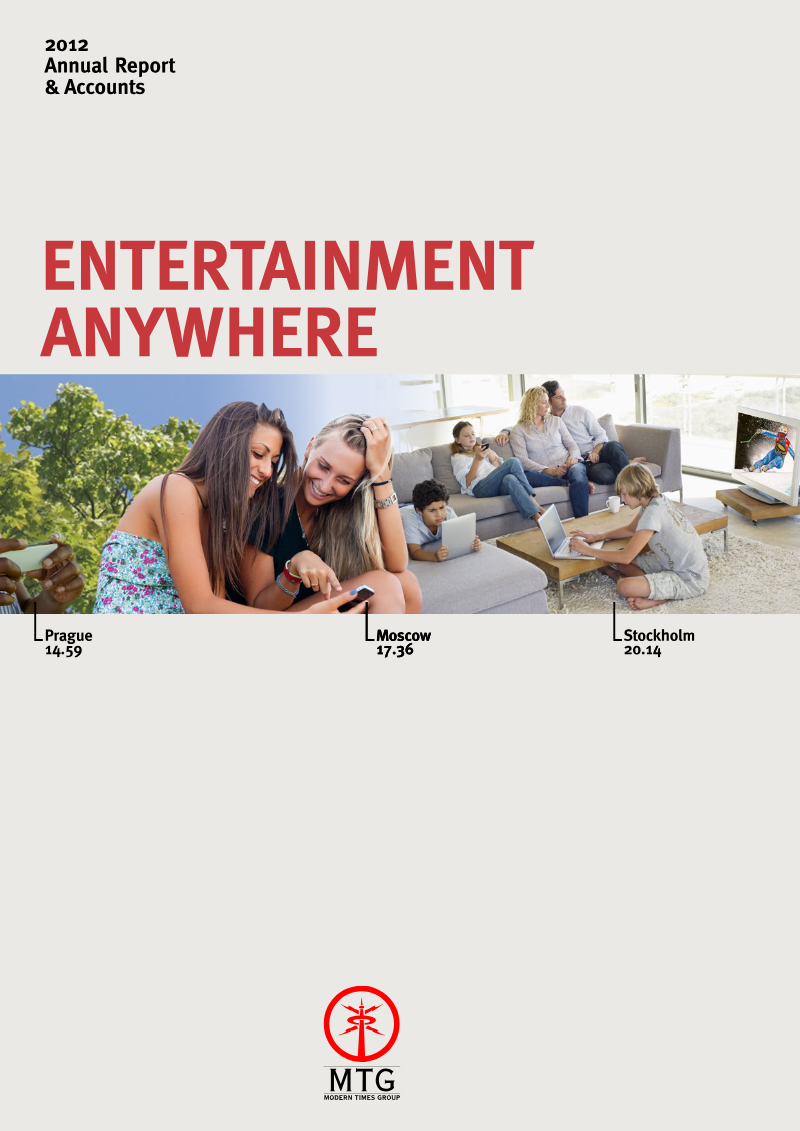
The 2012 annual report presents Modern Times Group AB’s financial performance, strategic actions and sustainability initiatives, positioning the company as a financially robust, diversified media operator seeking growth through acquisitions and digital expansion. Net sales reached SEK 13.3 billion, operating profit rose to SEK 2.1 billion and net profit recovered to SEK 1.6 billion, delivering basic earnings per share of SEK 17 after a loss‑making 2011. Free‑cash‑flow increased 6 % to SEK 1.8 billion, enabling a 20 % dividend rise to SEK 600 million and leaving net debt essentially at zero, while capital spending remained modest at 1 % of revenue. Revenue growth was uneven across segments. Nordic pay‑TV sales grew 4 % to SEK 4.4 billion with a 4 % lift in ARPU, yet operating profit fell; free‑TV Scandinavia declined 4 % and margins contracted. In contrast, emerging‑market free‑TV sales were flat on a constant‑currency basis but operating profit surged nearly five‑fold, reflecting the impact of new pay‑TV investments. The year featured several strategic acquisitions—including TV Sport, a majority stake in Zitius Service Delivery, Paprika Latino and Latvia’s Latvijas Neatkarīgā Televīzija—and the divestiture of Bet24
Modern Times Group’s 2009 annual report presents a year of contrasting outcomes, combining modest revenue growth with a substantial net loss driven primarily by non‑recurring impairments. Net sales rose to SEK 14.2 billion, up from SEK 13.2 billion the prior year, while operating income before exceptional items reached SEK 1.65 billion. A goodwill and asset‑impairment charge of roughly SEK 3.35 billion turned operating results negative, producing a consolidated net loss of SEK 2.0 billion and a loss per share of SEK 30.97. Despite the loss, the group generated SEK 1.5 billion of net operating cash flow, reduced net debt to SEK 2.7 billion (1.1 × EBITDA), and retained SEK 3.8 billion in liquid funds, supporting a proposed dividend of SEK 5.50 per share and authorization to repurchase up to 10 % of outstanding shares. The report underscores a strategic shift toward emerging‑markets pay‑TV, where revenue grew 33 % to SEK 875 million and operating profit increased 59 % to SEK 168 million, while subscriber numbers expanded across premium, basic and mini‑pay services. Digital retail sales also rose 26 %, reflecting diversification beyond traditional broadcasting. Governance is highlighted through a board of eight non‑executive directors, active remuneration and audit committees, and a Modern Responsibility framework that integrates employee development, carbon‑footprint auditing, ISO 14001 certification and green‑building standards. Approximately 86 % of staff completed performance surveys and 61 % of permanent employees received training, indicating strong internal engagement. Financial risk management remains a priority, with the group maintaining sufficient credit facilities, modest exposure to transaction‑level hedges, and an unhedged translation risk profile. IFRS updates slated for 2010 are expected to affect disclosures but not the core financial position. Overall, the 2009 performance reflects a resilient cash position and growth in high‑margin emerging markets, offset by significant impairment charges and a need for continued debt discipline.
Modern Times Group recorded a solid top‑line expansion in 2014, with net sales rising 11 % to SEK 15.7 billion on a constant‑exchange‑rate basis. Growth was split between 4 % organic increase and a further 7 % generated by acquisitions, notably the 2013 purchase programme that expanded the group’s presence in the Nordic pay‑TV and emerging‑market segments. Operating profit slipped modestly, falling 3–4 % to roughly SEK 1.3 billion and delivering an 8.1 % operating margin, while cash flow remained robust and net debt was cut to 0.2 × EBITDA, half the level of the prior year. The board proposed, and shareholders approved, a cash dividend of SEK 10.50 per share—about 57 % of net income—resulting in a payout of SEK 700 million. At year‑end the market capitalisation stood at SEK 16.8 billion, with 17,721 shareholders; the ten largest owners held 47 % of the equity and 64 % of voting rights, and Swedish institutional investors owned roughly 59 % of the shares. Segment performance was mixed. Free‑TV Scandinavia delivered flat revenue with a slight profit decline, while Pay‑TV Nordic posted an 8 % sales increase and a 14 % rise in operating profit. Broadcasting contributed SEK 13.2 billion of the total revenue and generated SEK 2.12 billion of operating profit, marginally below the previous year. The group continued to hedge virtually all USD and EUR programme‑acquisition exposures, maintaining a SEK 137 million hedging reserve, and held full‑coverage insurance on its assets. Corporate governance was overseen by a seven‑member board, four of whom were classified as independent, supported by remuneration, audit and a newly created corporate‑responsibility advisory committee. The board approved all major investments, acquisitions and disposals above SEK 2 million. Financial statements were prepared under IFRS, with joint ventures now accounted for using the equity