1 free read left. Create a free account for unlimited reading + AI research.
Create free accountArticle DiGRA
1 free read left. Create a free account for unlimited reading + AI research.
Create free accountArticleDiGRA
Taxonomies borrowed from traditional cartography or tabletop gaming struggle with boundary cases.
This analysis presents a novel classification system for video game cartographic maps, developed through the examination of 132 map designs sourced from 23 online articles and posts. The primary objective is to establish a framework that connects map design principles with interface functionalities, thereby illuminating patterns in map functions, affordances, gameplay styles, and player experiences. A key challenge identified was the divergence between the game industry's broad use of "world map" to denote total playable space and traditional cartographic definitions, necessitating a refined approach to categorize diverse game environments, including city-centric or extraterrestrial settings.
The classification system comprises five main categories: World Map, Area Map, City Map, Blueprint, and Minimap. The "Area Map" category represents the largest proportion of the analyzed sample at 36%, followed closely by "World Map" at 31%, and "Blueprint" at 18%. "City Map" and "Minimap" were less frequent, accounting for 11% and 4% respectively. The study acknowledges inherent difficulties in classification due to ambiguous boundaries between map types and the influence of geo-cultural elements, noting that map design is significantly shaped by game genre, setting, and core gameplay mechanics.
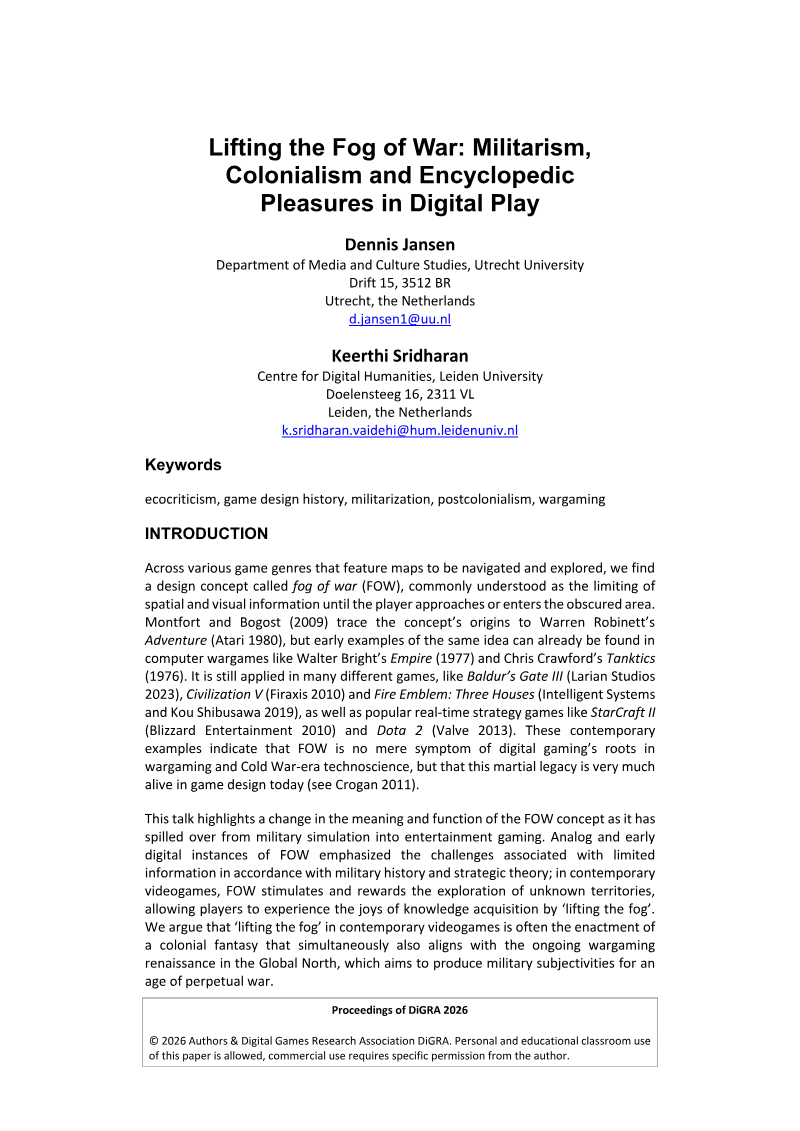
Ultimately, game maps are designed to enrich player engagement and exploration, often employing abstraction, feature exaggeration, and scale manipulation. Various functionalities are observed, such as hidden or incomplete maps that foster discovery, exemplified by "fog of war" mechanics or fragmented map collection. Additionally, diegetic maps, which are integrated directly into the game world, enhance player immersion. The findings underscore the importance of continued research into the diverse categories of game maps, their specific functions, aesthetic qualities, and their profound impact on player perception and narrative progression.

DiGRA · 2026

DiGRA · 2026



DiGRA · 2026



DiGRA · 2026



DiGRA · 2026



DiGRA · 2026



DiGRA · 2026



DiGRA · 2026



DiGRA · 2026

DiGRA · 2026



DiGRA · 2026



DiGRA · 2026

Thomas Brush · 2026