1 free read left. Create a free account for unlimited reading + AI research.
Create free accountArticle Quantic Foundry
1 free read left. Create a free account for unlimited reading + AI research.
Create free accountArticleQuantic Foundry
The research uses a standardized model to measure 12 distinct psychological drivers.
Key finding. The study identified 12 distinct motivations that define a gamer's profile.
Quantic Foundry's December 2016 analysis examines the primary gaming motivations of more than 250,000 gamers worldwide who completed its five-minute Gamer Motivation Profile survey. The model measures 12 motivations, derived through statistical clustering, and scores each respondent as a percentile relative to the full dataset. Each gamer's highest-scoring motivation is designated their primary motivation, and the analysis compares how these primaries are distributed across gender and age segments.
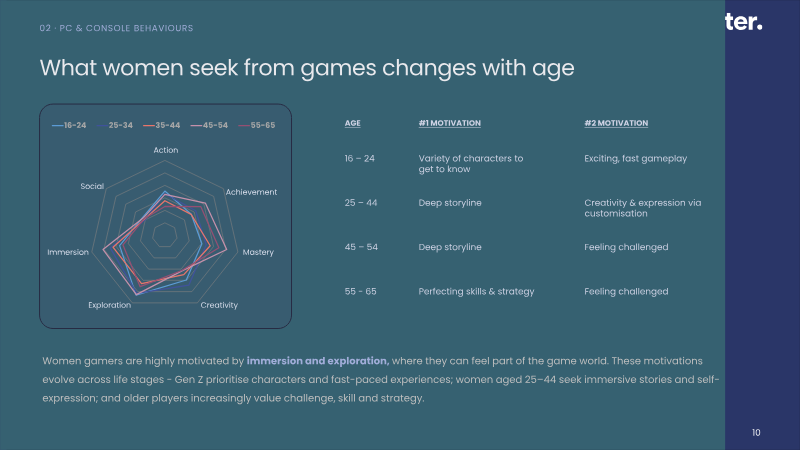
Gender differences largely follow stereotype. Among men (n=207,050), Competition and Destruction are the most common primary motivations, while Discovery and Power are the least common. Among women (n=47,273), Completion and Fantasy lead, while Excitement and Challenge are least common. Women's preferences are more polarized: the ratio between the most and least common primary motivation is 5.7 for women versus 2.5 for men, and the top three motivations cover 47.7% of women but only 36.2% of men. Non-binary gamers (about 1.1% of respondents, n=2,819) show the greatest concentration, led by Fantasy and Design, with a 8.5 ratio and 50.2% covered by the top three. The author notes the cause of polarization is unclear, and argues in comments that it is not a sample size artifact.
Age effects are equally striking. Among ages 13-25 (n=134,562), Competition leads and is nearly 50% more frequent than second-place Destruction, the steepest top-to-second drop in the analysis. Among gamers 36 and older (n=30,367), Competition falls from first to ninth, with Fantasy and Completion on top and Excitement and Challenge at the bottom.
The central takeaway is that Completion ranks in the top three for every segment, making it a low-risk, broadly appealing motivation, which helps explain the wide demographic reach of games like Pokemon Go that avoid polarizing drivers such as Competition. Reader comments raise critiques about the survey's ambiguity around Completion, its omission of motivations like autonomy, and its game-agnostic framing; the author responds that the model is configural and measures the player rather than specific games. Data covers a self-selected, global online sample, and children under 13 are excluded for legal reasons.
Quantic Foundry · 2026
Quantic Foundry · 2025
Quantic Foundry · 2025
Quantic Foundry · 2025
Quantic Foundry · 2025
Quantic Foundry · 2024
Quantic Foundry · 2023
Quantic Foundry · 2023
Quantic Foundry · 2023
Quantic Foundry · 2021
Quantic Foundry · 2021
Quantic Foundry · 2021
DiGRA · 2026